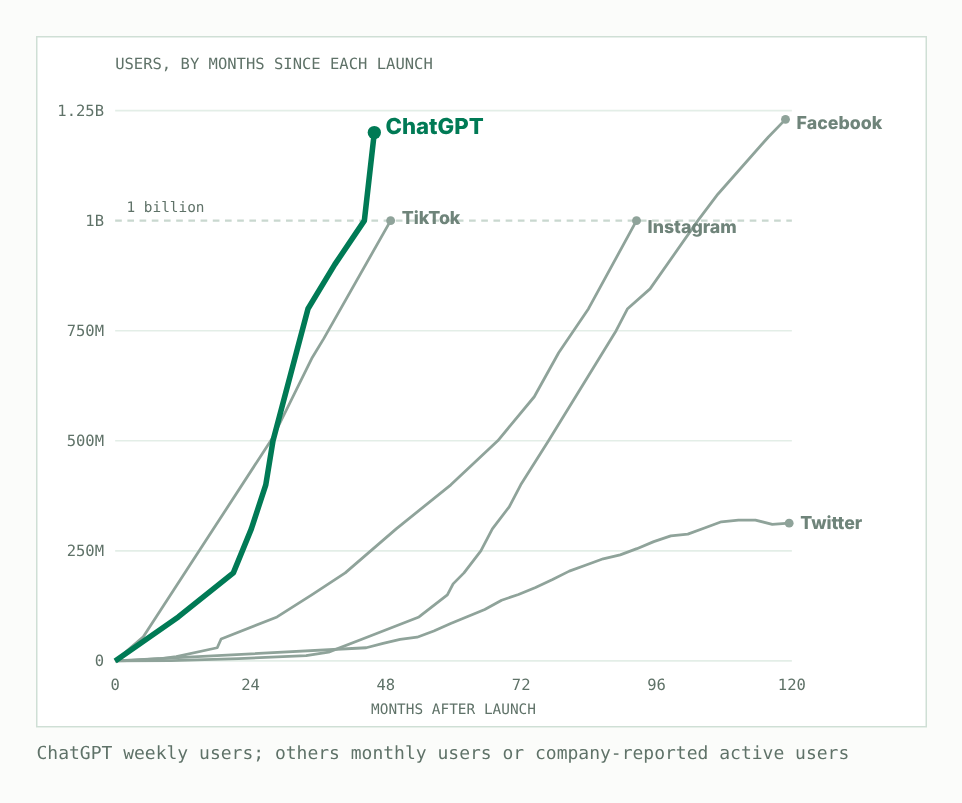
ChatGPT reached a billion weekly users in under four years. Facebook took eight and a half
Scroll through the interactive version of this story →
We lined up the AI assistants against the biggest social apps, counting from each one's launch day. By their own monthly counts, two AI rivals got there sooner. Both are built into apps that billions of people already use.
OpenAI released ChatGPT on Nov. 30, 2022. Within a year it had 100 million weekly users. OpenAI later said ChatGPT passed 1 billion weekly users in August, and by late September it was citing 1.2 billion weekly users, 46 months after launch.
The chart compares ChatGPT with Facebook, Instagram, TikTok and Twitter, each counted from its own launch. At the same age, TikTok was ahead of ChatGPT for about two and a half years, but ChatGPT reached a billion sooner than all four. Twitter never got there; its reported monthly users peaked around 336 million in early 2018, before it stopped publishing the figure.
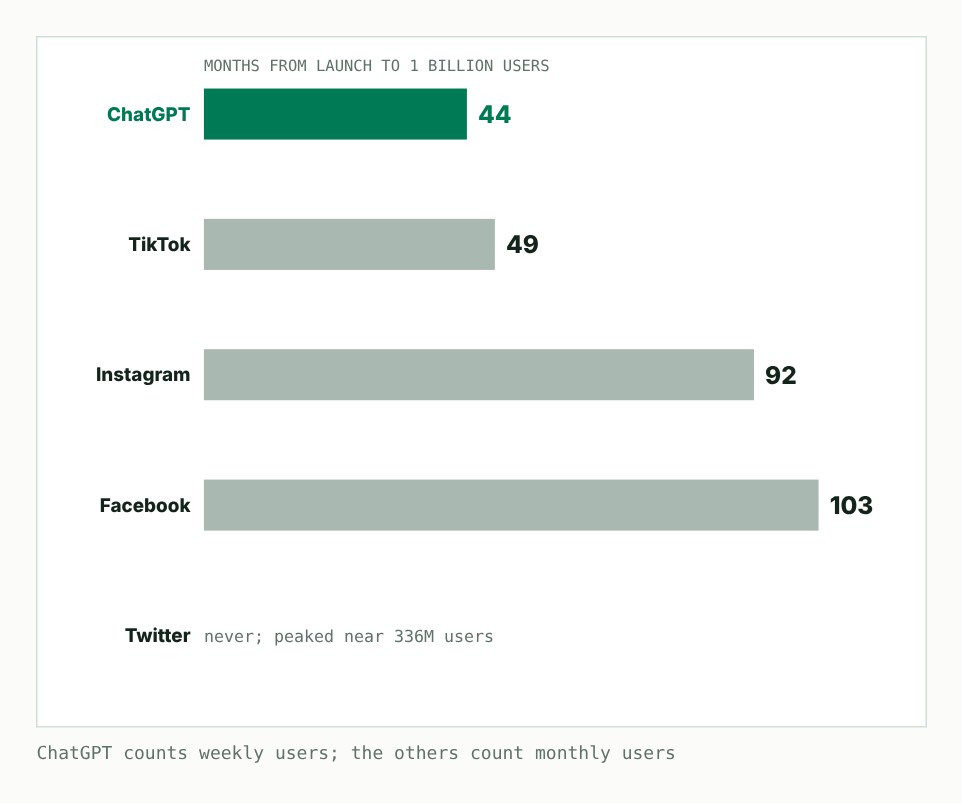
Counting months to a billion users, ChatGPT took about 44, a little faster than TikTok's 49 and less than half of Instagram's 92 or Facebook's 103. ChatGPT's count is also stricter, because OpenAI reports people who use it each week, while the others report monthly users.
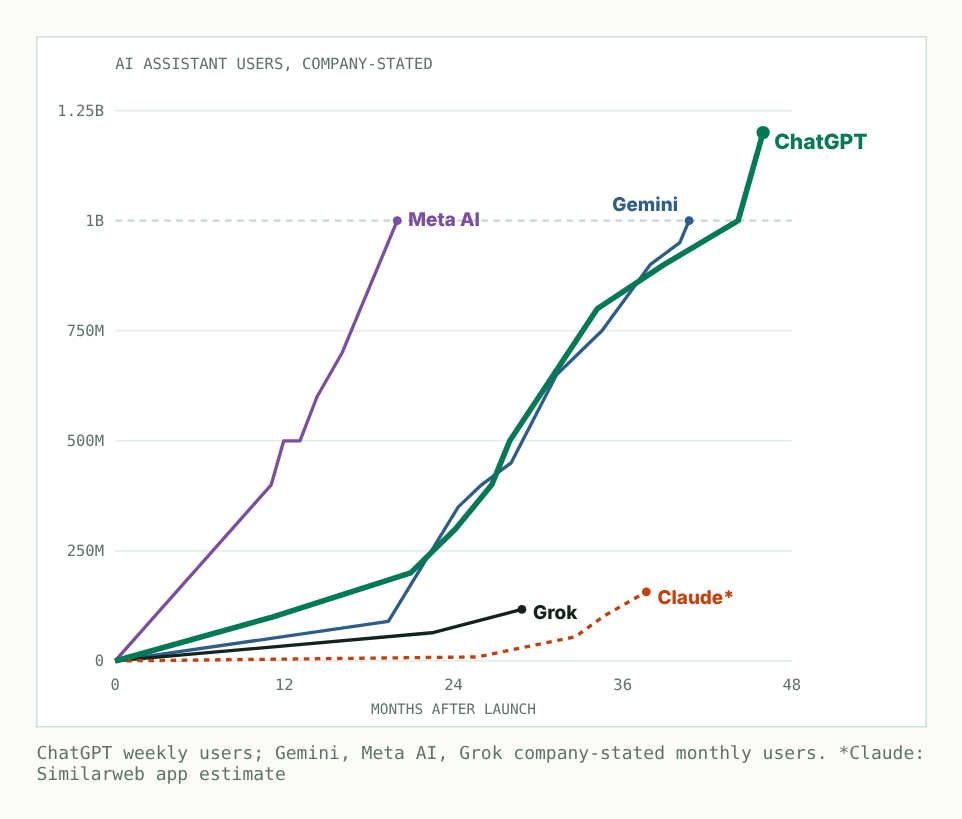
ChatGPT was not the first AI assistant to a billion, though. By the companies' own counts, Meta AI reached a billion monthly users in 20 months and Google's Gemini in about 41. Both sit inside products people already used, from WhatsApp and Instagram to Android phones. SpaceX's IPO filing puts xAI's Grok at 117 million monthly users as of March.
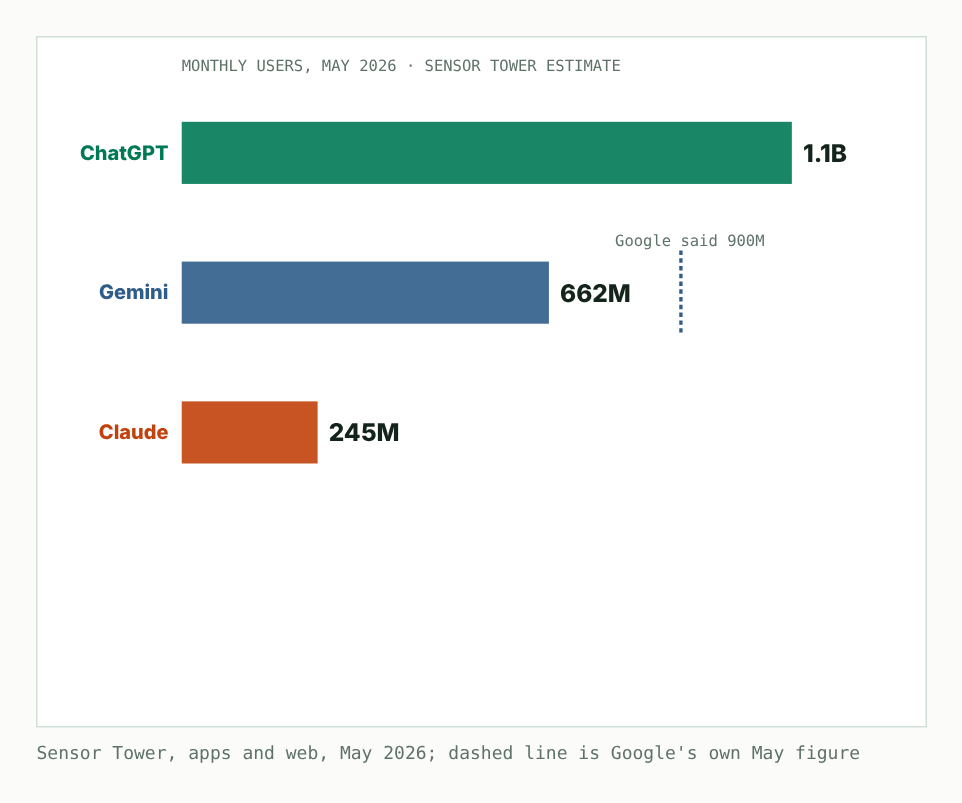
Each company measures in its own way, so independent panels help. Sensor Tower's May estimate, which applies one method to every app, put ChatGPT at about 1.1 billion monthly users and Gemini at 662 million, well below the 900 million Google announced that month. Claude, from Anthropic, was at about 245 million.
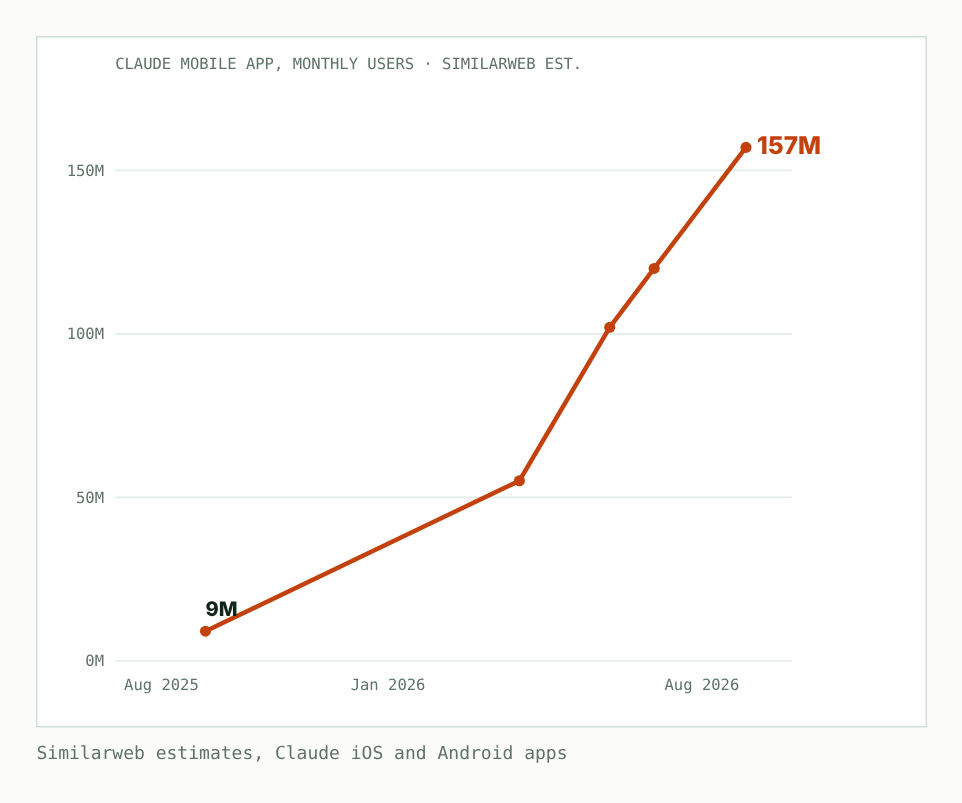
Anthropic does not publish absolute user counts, but app data shows Claude growing fastest in percentage terms over the past year, from a small base. Similarweb estimates Claude's mobile app had 9 million monthly users in August 2025 and 157 million in August 2026, about 17 times as many.
What's next
Google updates Gemini's count at its earnings calls, and OpenAI updates ChatGPT's at product events. Meta has not given a Meta AI total since May 2025, and Anthropic has not published one. We will update the race chart when new numbers arrive.
How we counted: months are measured from each product's launch: ChatGPT Nov. 30, 2022; Bard, now Gemini, March 21, 2023; Claude's consumer app July 11, 2023; Meta AI Sept. 27, 2023; Grok Nov. 4, 2023, as a limited beta; Facebook Feb. 4, 2004, at Harvard only; Twitter July 15, 2006; Instagram Oct. 6, 2010; and TikTok's international app September 2017, excluding Douyin in China. ChatGPT figures are OpenAI's weekly active users; OpenAI's 1 billion milestone is dated to August, with reports ranging from Aug. 6 to a mid-August snapshot OpenAI confirmed on Sept. 8. OpenAI described the late-September figure as "our collective 1.2B weekly users." Gemini and Meta AI figures are company-stated monthly users; Grok's 117 million comes from the SpaceX S-1, which does not say how it counts use inside X. Facebook figures before 2012 and Instagram's early figures are company-announced "active users" or registrations rather than formal monthly active users. Twitter figures are quarterly averages from its S-1 and later reports; the chart shows its first 10 years, and its reported peak of 336 million came in the first quarter of 2018. TikTok figures come from a January 2018 report, its 2020 court filing, a leaked 2020 advertising deck and its 2021 announcement; its curve includes Musical.ly users absorbed in the August 2018 merger. Claude figures are third-party estimates from Sensor Tower (May 2026) and Similarweb (mobile apps only).
You may republish the charts in this story, with credit to The News in Data and a link to this story.