Every monthly jobs estimate in 2025 was later revised down, while 2026 revisions have split evenly
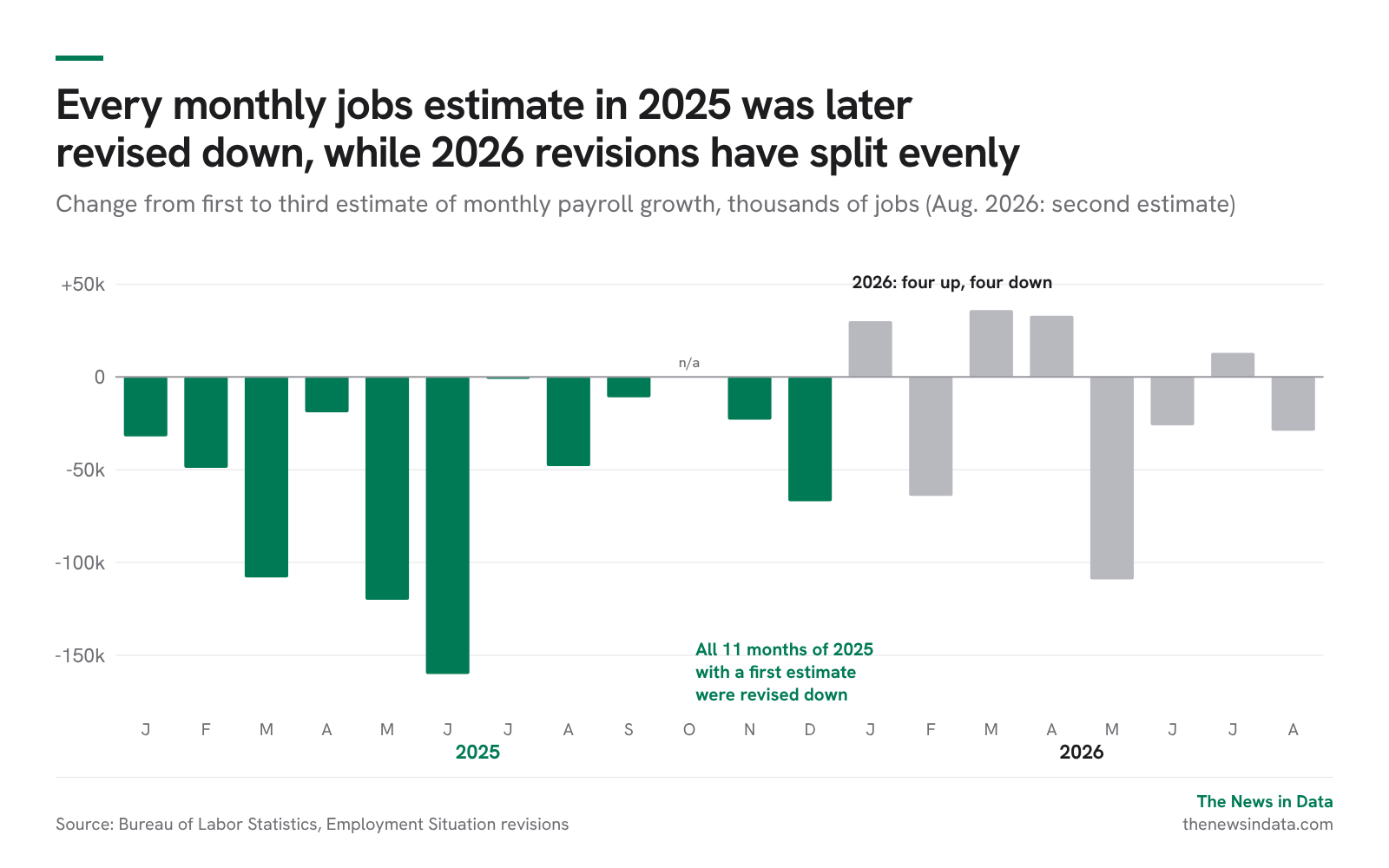
The Bureau of Labor Statistics revised every 2025 monthly payroll estimate downward as later data came in. Across the 11 months that had a first estimate, the third estimate came in a combined 638,000 jobs lower than the first, an average of 58,000 a month. This year has gone differently so far, with four months revised up and four revised down through August.
Why the numbers move
Each monthly jobs report comes from a survey of employers, and many of them send in their payroll counts late. BLS publishes a first estimate soon after the month ends and revises it in each of the next two reports as more responses arrive. Once a year it also lines the whole series up with unemployment-insurance tax records, which cover nearly every employer, in what it calls the benchmark revision.
2025 was revised down twice
The green bars in the chart are the 2025 revisions, which ranged from 1,000 jobs in July to 160,000 in June, when a first estimate of +147,000 became −13,000 by the third. After the annual benchmark, published in February 2026, lowered the March 2025 employment level by 898,000, the 11 months of 2025 now show a combined 1.06 million fewer jobs than first reported. January 2025, first reported as a gain of 143,000, now stands as a loss of 48,000.
2026 is split by count but leans down by size
This year January, March, April and July were revised up, and February, May, June and August were revised down. The downgrades were larger, so the eight months together now show 116,000 fewer jobs than first reported. May accounts for most of that, falling from +172,000 at first print to +63,000.
Where the "always revised down" thesis breaks
A common reading of 2025 is that first estimates are built to run high. If that were true we would expect 2026 to look the same, and so far it doesn't by count, since revisions this year have been as likely to go up as down, even though the net is still 116,000 jobs lower. The preliminary benchmark for March 2026, at −79,000, is also much smaller than last year's final benchmark revision of −898,000.
What's next
The first estimate for September was +29,000, released Oct. 2, against forecasts of about 90,000, and the unemployment rate rose to 4.2%. September's first revision comes with the October report, and the 2026 benchmark will be applied in February 2027.
How we counted: first, second and third estimates of the monthly change in total nonfarm payrolls, seasonally adjusted, from the BLS revisions table, with latest values from FRED (PAYEMS, Oct. 2 vintage). The chart shows the third estimate minus the first, which excludes the annual benchmark. August 2026 has had only its second estimate. October 2025 had no first estimate because of the government shutdown.