Americans Are Living On Two Different Dates For 21 Hours Of Every Day
Scroll through the interactive version of this story →
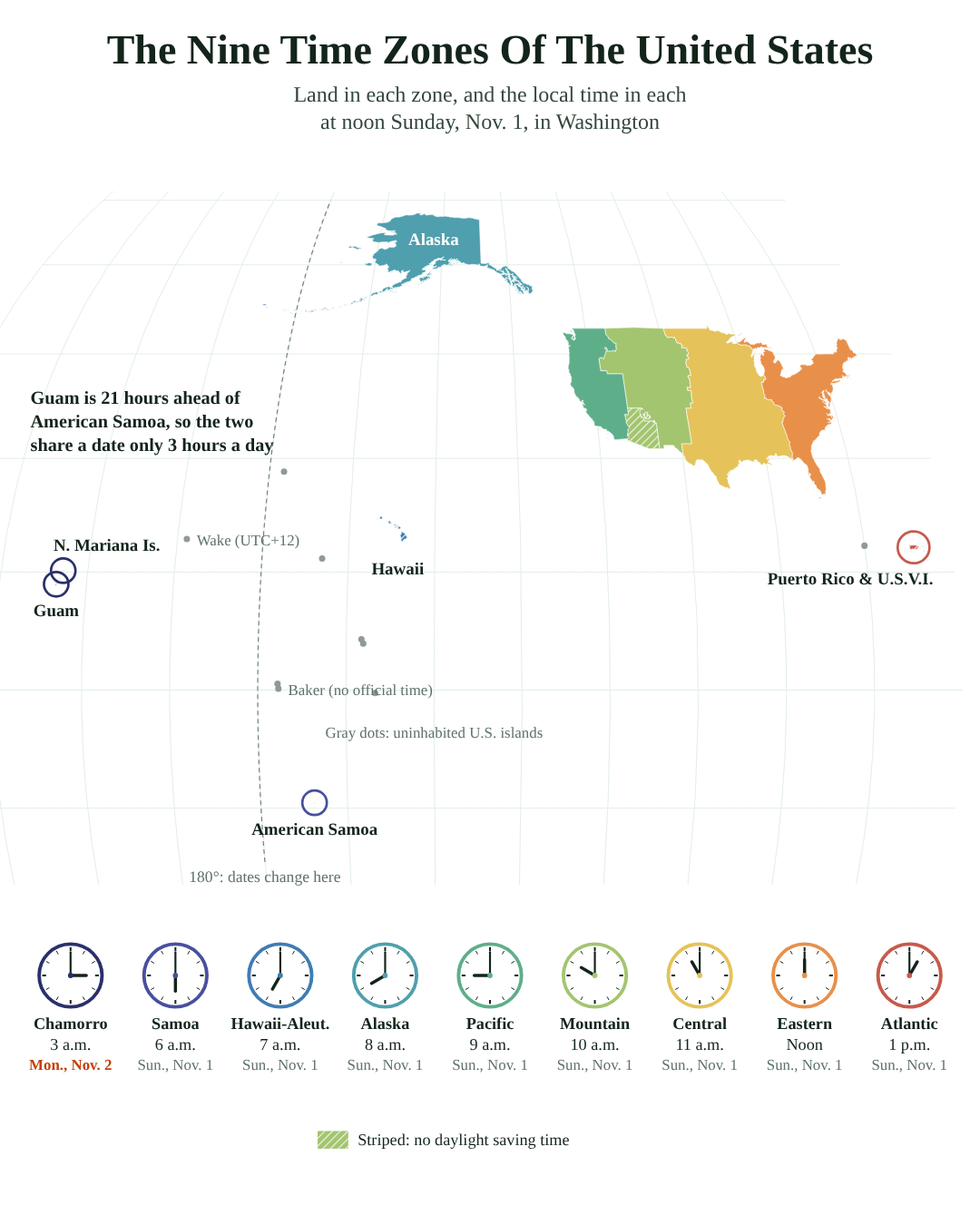
Guam and the Northern Mariana Islands keep time 10 hours ahead of Coordinated Universal Time (UTC), and American Samoa keeps time 11 hours behind it, so the two ends of the country are 21 hours apart. Both are on the same calendar date for only three hours a day, from 11:00 to 14:00 UTC, which after clocks fall back Sunday is 6 to 9 a.m. Eastern time. At noon Sunday in Washington, it will already be 3 a.m. Monday in Guam and 6 a.m. Sunday in Pago Pago.


Nine zones, set by federal law


Federal law defines nine standard time zones by their distance from UTC, from 4 hours behind (Atlantic, used by Puerto Rico and the U.S. Virgin Islands) to 11 hours behind (Samoa), plus one zone 10 hours ahead (Chamorro). The Department of Transportation draws the lines between them. The country's uninhabited islands stretch the span further: Wake Island keeps time 12 hours ahead of UTC in the standard time zone database, and Baker and Howland islands, which have no residents and no official time, sit in the nautical zone 12 hours behind it.
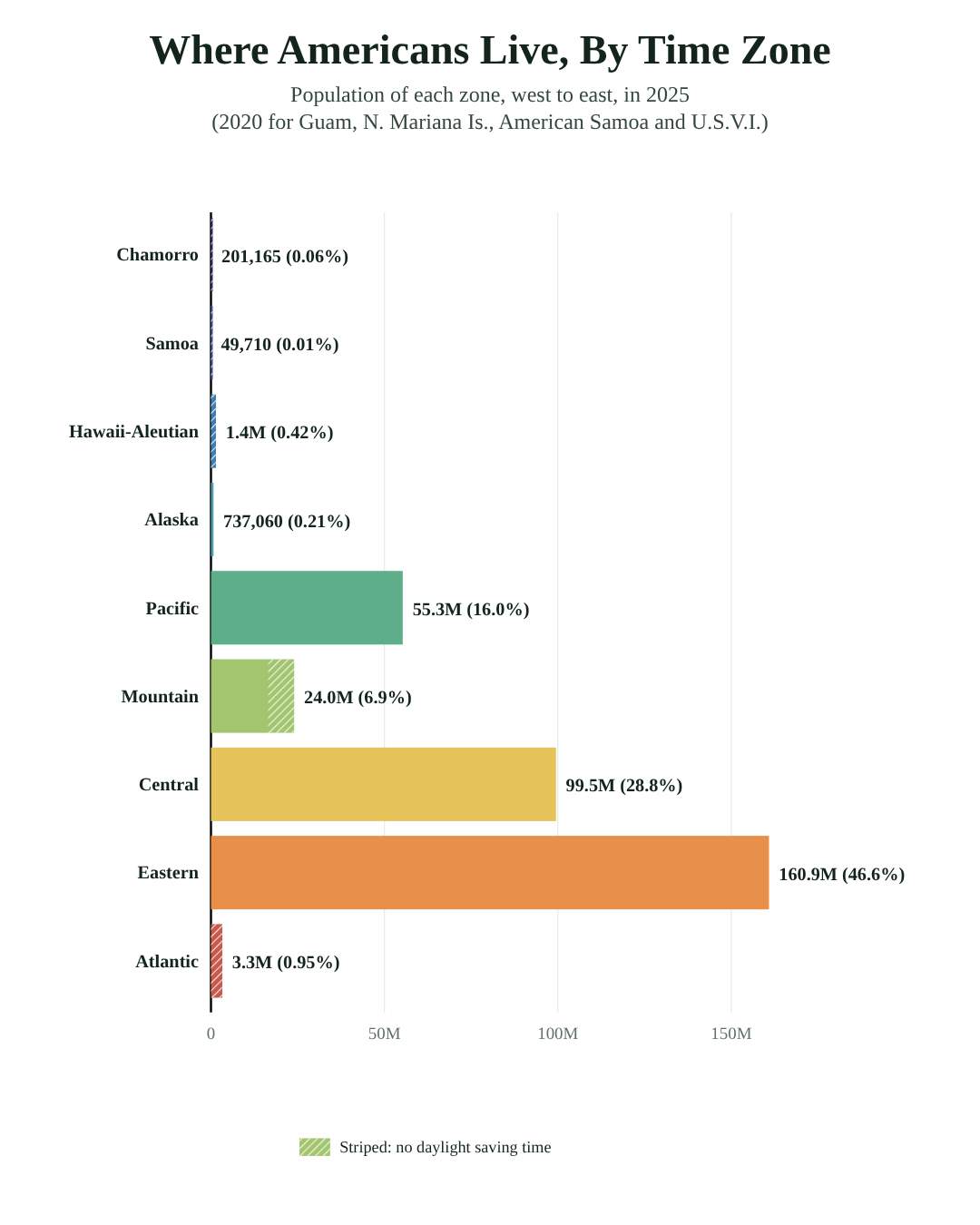
Nearly half of Americans live in the Eastern zone
The Eastern zone holds 160.9 million people, 46.6% of the 345.3 million in the states, D.C. and the territories, followed by Central at 99.5 million (28.8%) and Pacific at 55.3 million (16.0%). Mountain has 24.0 million (6.9%), about a quarter of Central's population. The other five zones together hold 5.7 million people, 1.6% of the total, and the smallest, Samoa, has 49,710.
12.5 million won't change their clocks Sunday
Daylight saving time ends at 2 a.m. local time Sunday, Nov. 1, when clocks in most of the country fall back to 1 a.m. About 332.9 million people, 96.4% of the total, live where clocks change. The 12.5 million who stay on standard time all year are about 7.5 million in Arizona outside the Navajo Nation, 1.4 million in Hawaii, 3.2 million in Puerto Rico and 338,021 in the four island territories.
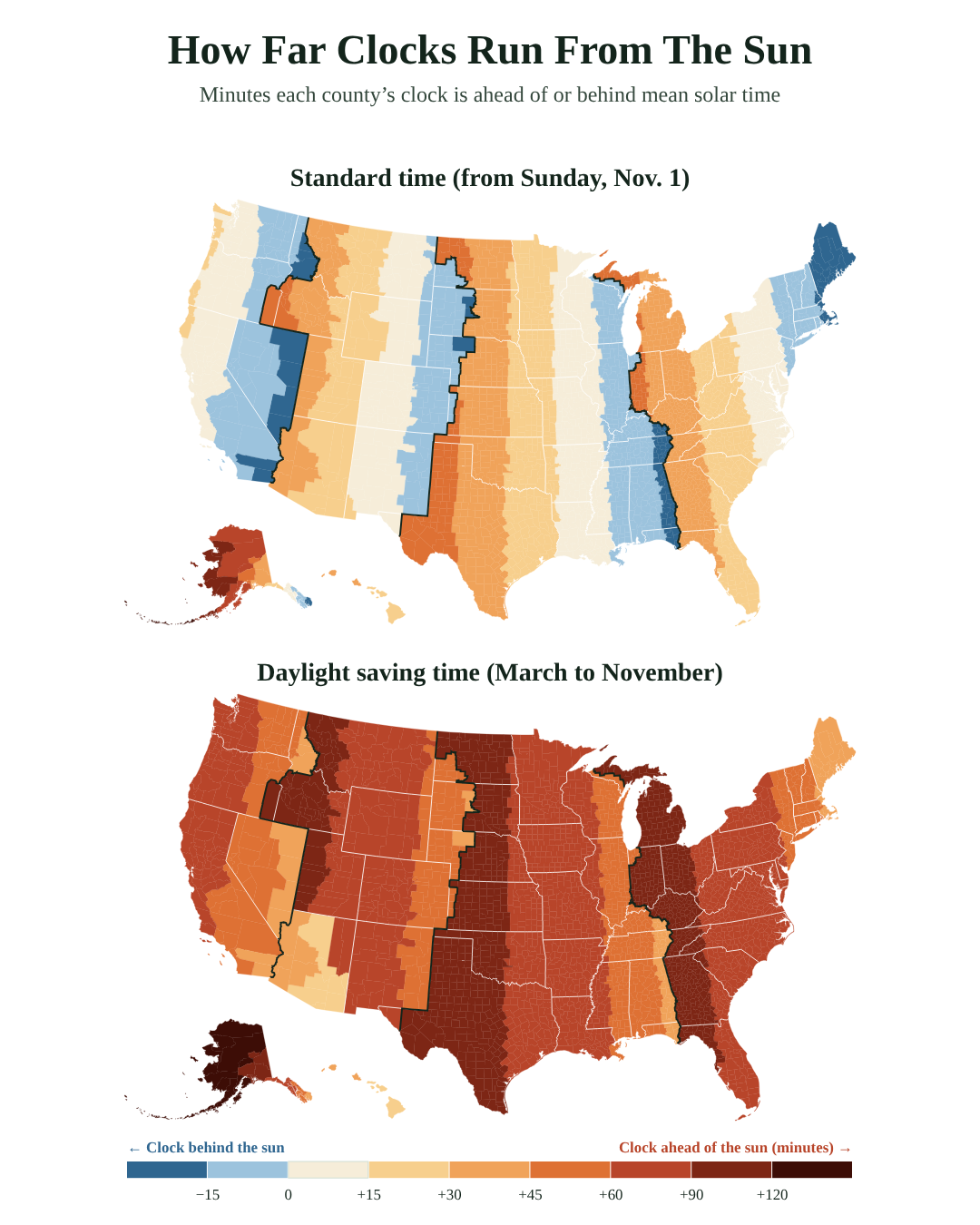
After Sunday, most clocks sit close to the sun


Each zone's clock is set to the sun's position along one line of longitude, so places west of that line see the sun cross its highest point after noon. Once clocks fall back, 80% of people in the 50 states and D.C. will live in counties where the clock is within 30 minutes of the sun's time, and 30% will live where the clock runs behind it, mostly on the eastern side of a zone. The largest gaps are in western Alaska, which keeps the same clock as Anchorage; in Gambell, on St. Lawrence Island, the clock runs about 2 hours 27 minutes ahead of the sun.
Daylight time moves clocks an hour further ahead
From March to November, the same counties run an hour further ahead. Under daylight saving time, 67% of people in the 50 states and D.C. live where the clock runs at least an hour ahead of the sun and 18% live where it runs at least 90 minutes ahead, compared with fewer than 1% within 30 minutes. In Gambell the gap reaches about 3 hours 27 minutes, so the sun is highest in the sky around 3:30 p.m.
A bill would make the summer numbers permanent
The House passed the Sunshine Protection Act on July 14 by a vote of 308 to 117, and the bill is now with the Senate Commerce Committee. It would keep daylight saving time all year and let states choose to stay on standard time instead. The Senate passed an earlier version in 2022, but the House never took it up. If it becomes law, the daylight-time map would become the year-round map for every state that doesn't opt out, while Arizona, Hawaii and the territories already use standard time all year.
What the data can't tell us
The clock-and-sun comparison uses each county's geographic center, not where its residents live, and uses mean solar time, which ignores a seasonal swing of up to about 16 minutes in when the sun actually peaks. A few counties are split between zones, and their populations are divided by land area. The boundaries follow local practice as recorded by the timezone-boundary-builder project, which in a few places, such as Phenix City, Ala., differs from the official federal line.
How we counted: time zone boundaries from the timezone-boundary-builder project (release current as of Oct. 2026), based on the IANA time zone database, matched to Census Bureau county boundaries. Population: Census Bureau Vintage 2025 estimates for July 1, 2025, for the states, D.C. and Puerto Rico; 2020 Census counts for Guam (153,836), the Northern Mariana Islands (47,329), American Samoa (49,710) and the U.S. Virgin Islands (87,146), which have no annual estimates. Clock-versus-sun gap = the zone's standard UTC offset minus each county center's longitude divided by 15 degrees per hour. Zone definitions: 15 U.S.C. 261 and 49 CFR Part 71. Sources: 15 U.S.C. 261; 49 CFR 71; Census Bureau Vintage 2025 county estimates; Census Bureau, 2020 Island Areas counts; timezone-boundary-builder; ABC News, July 15, 2026.
You may republish the charts in this story, with credit to The News in Data and a link to this story.