Renewables Now Generate More Than Three Times As Much Of The World’s Electricity As Nuclear Power Does
Scroll through the interactive version of this story →
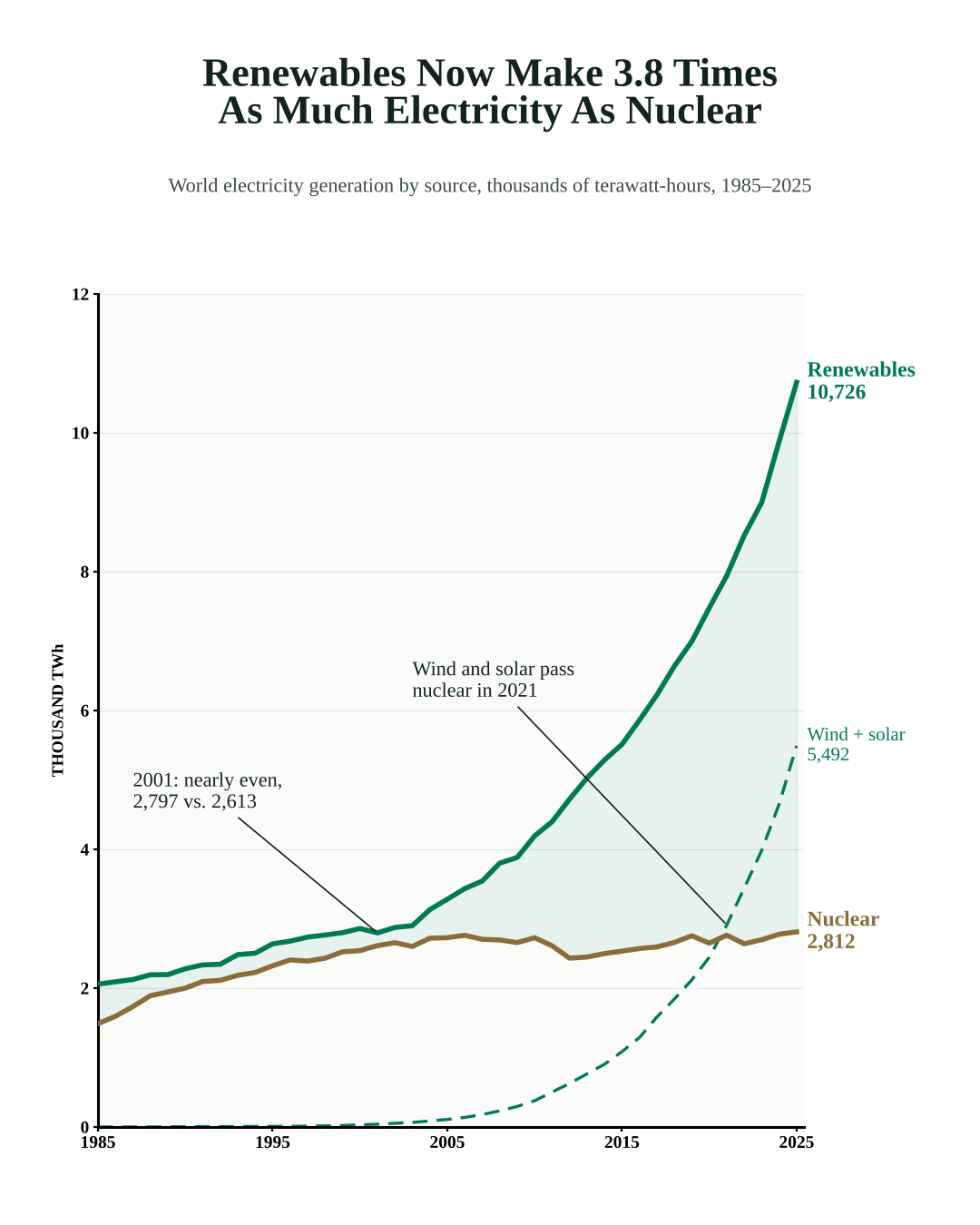
Renewable sources generated 10,726 terawatt-hours of electricity worldwide in 2025, 3.8 times the 2,812 terawatt-hours from nuclear plants, according to Ember data compiled by Our World in Data. As recently as 2001, renewables produced only 7% more than nuclear, 2,797 terawatt-hours to 2,613.
Nuclear output hit a record, but its share fell by half
Nuclear plants generated more electricity in 2025 than in any earlier year, 35 terawatt-hours more than in 2024, but only 1.8% more than in 2006. Over those same 19 years, world electricity generation grew 69%, so nuclear's share fell from 14.7% in 2006 to 8.8% in 2025, about half its 1996 peak of 17.4%. Renewables' share rose from 18.2% to 33.8% over the same period, which Ember says made them a larger source of electricity than coal (33.0%) for the first time.
Wind and solar made up the difference
Wind and solar together produced 5,492 terawatt-hours in 2025, almost twice nuclear's output, after passing it for the first time in 2021. Solar alone grew 30% in a year, to 2,779 terawatt-hours, within about 1% of nuclear. From 2015 to 2025, renewable generation grew by 5,214 terawatt-hours, nearly 19 times the 279-terawatt-hour gain from nuclear.
Hydropower is still the biggest renewable
Dams produced 4,435 terawatt-hours in 2025, 41% of all renewable electricity and about 1.6 times nuclear output. Hydropower has produced more electricity than nuclear in every year since 1985 except 2001 and 2002. Bioenergy and other renewables added 800 terawatt-hours.
What could change the gap
About 70 reactors were under construction or in development in 15 countries, 39 of them in China, according to a Pew Charitable Trusts summary of Ember's Global Electricity Review 2026. A 1-gigawatt reactor running 90% of the time produces about 8 terawatt-hours a year, so even 70 such reactors would add about 550 terawatt-hours, less than solar output grew in 2025 alone (636 terawatt-hours).
What the data can't tell us
These figures measure electricity generated, not capacity, and a nuclear plant runs most hours of the year while solar panels produce only in daylight, so the comparison says nothing about which source is more reliable or cheaper. Renewables here include hydropower, wind, solar, bioenergy, geothermal and tidal power. The 2025 figures are Ember's first estimates and may be revised.
How we counted: world electricity generation by source, 1985–2025, from Our World in Data's energy dataset, which uses Ember (2000 onward) and the Energy Institute's Statistical Review of World Energy (earlier years). Renewables are the sum of hydropower, wind, solar, bioenergy and other renewables. Shares are of total electricity generation. Reactor pipeline: Pew Charitable Trusts, July 14, 2026, citing Ember. Sources: Our World in Data energy dataset; Ember, Global Electricity Review 2026, April 21, 2026; Pew Charitable Trusts, July 14, 2026.
You may republish the charts in this story, with credit to The News in Data and a link to this story.