The President’s Party Has Lost House Seats In 18 Of The 20 Midterms Since World War II
Scroll through the interactive version of this story →
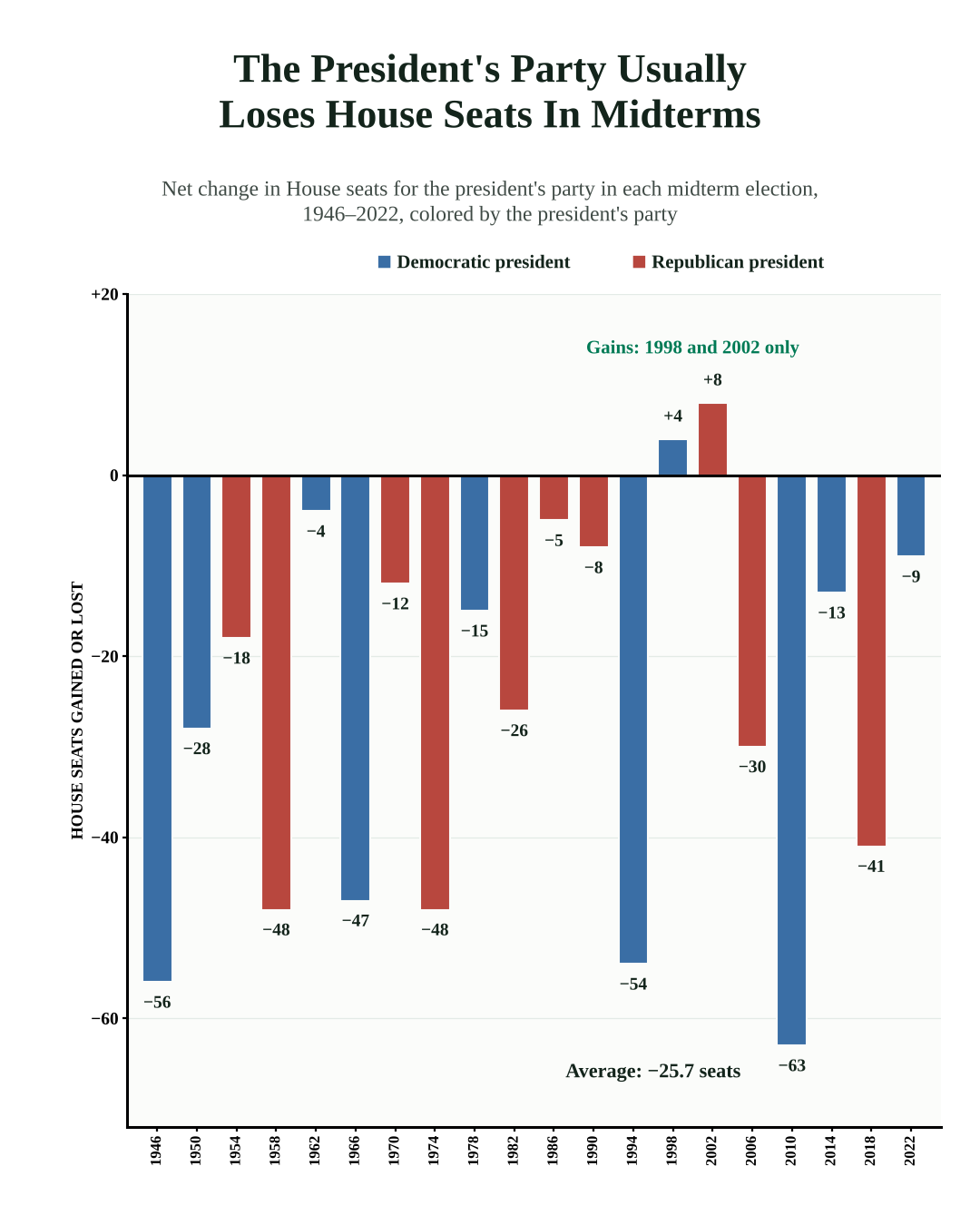
The president's party lost House seats in 18 of the 20 midterm elections from 1946 to 2022, according to the American Presidency Project at UC Santa Barbara. The average change was a loss of 25.7 seats and the median a loss of 22.
The two exceptions
Democrats under Bill Clinton gained four House seats in 1998, and Republicans under George W. Bush gained eight in 2002. Before the war, Democrats under Franklin Roosevelt gained nine in 1934, so a gain has happened three times in 23 midterms since 1934.
The losses are large under both parties
The biggest loss was 63 seats for Democrats under Barack Obama in 2010, followed by 56 under Harry Truman in 1946 and 54 under Clinton in 1994. Democratic presidents' parties lost an average of 28.5 seats in their 10 postwar midterms, compared with 22.8 for Republican presidents' parties in their 10. The smallest losses were four seats in 1962 under John F. Kennedy and five in 1986 under Ronald Reagan.
The Senate pattern is weaker
In the Senate the president's party lost an average of 3.6 seats and gained seats in six of the 20 midterms, most recently in 2018 and 2022, and broke even in 1998. Only about a third of Senate seats are on the ballot in any year, so which states are voting shapes the result as much as the national mood.
What's next
The chart shows how often the pattern has held, and it can't explain why or tell us what will happen on Nov. 3. The Nov. 3 results will add a 21st postwar midterm to the chart, and final seat counts can take weeks in close races.
How we counted: seat changes are the American Presidency Project's table of seats gained or lost by the president's party in midterm elections; averages and medians are our calculations from that table for 1946–2022. Gerald Ford is counted as president in 1974. Source: American Presidency Project, UC Santa Barbara.
You may republish the charts in this story, with credit to The News in Data and a link to this story.