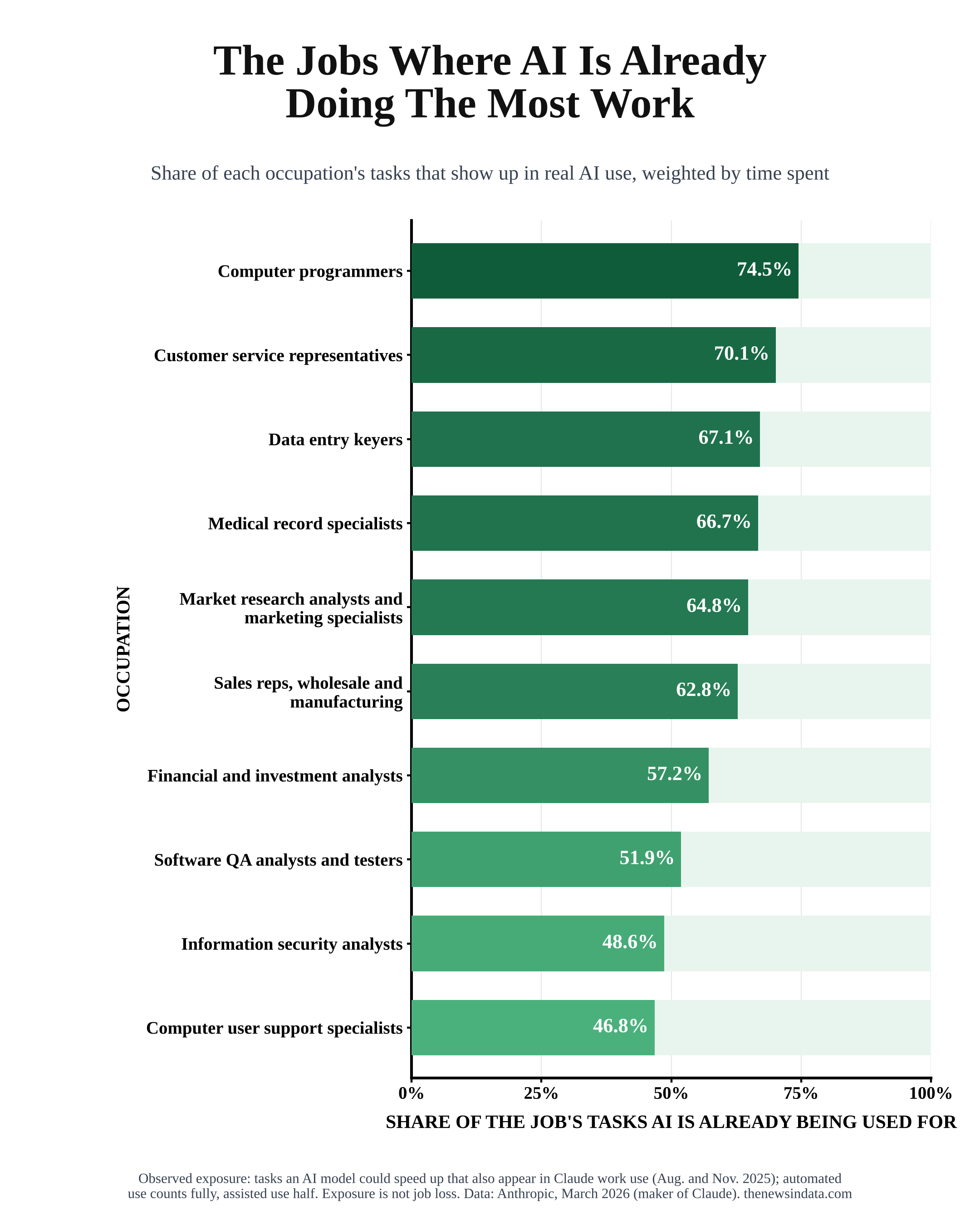
AI is already being used for 74.5% of computer programmers' work tasks, more than for any other occupation, according to a March 2026 study by Anthropic, the company that makes the Claude AI model. Customer service representatives (70.1%), data entry keyers (67.1%) and medical record specialists (66.7%) follow. Yet the study found no systematic rise in unemployment among the most exposed workers since ChatGPT's release in late 2022.
What "exposed" means
The study, by Anthropic economists Maxim Massenkoff and Peter McCrory, starts with a 2023 rating of every task in the Labor Department's O*NET job database for whether a large language model could do it at least twice as fast. It then keeps only the tasks that actually show up in work-related Claude conversations, counts tasks Claude performs fully and tasks it assists with at half weight, and weights each task by how much of the job it takes up. The result is a share of each job's work that AI is already doing or helping with, not a forecast of job losses. About 30% of U.S. workers, including cooks, bartenders, lifeguards and dishwashers, have no exposure at all.


Most of what AI could do, it isn't doing yet
Large language models could in theory speed up 94% of the tasks in computer and math jobs and 90% in office and administrative jobs, but Claude covers only about a third of computer and math tasks in practice. In grounds maintenance, the theoretical share is under 4%, and in transportation, agriculture, food service and construction it is under 20%.
How Much Of Each Job AI Could Speed Up
Share of each job category's tasks a language model could theoretically speed up. Tap a bar for details.
In computer and math jobs, AI could theoretically speed up 94% of tasks, but Claude was being used for only about a third of them.
Theoretical shares are Eloundou et al. (2023) task ratings as charted by Anthropic, "Labor market impacts of AI," March 2026, as reported by Euronews.
A second study finds the same pattern
Microsoft researchers scored 96 job groups on how well their work matches about 200,000 conversations with Bing Copilot. Media and communication workers scored highest at 0.38, followed by service sales representatives and information and record clerks. Forest and conservation workers, plant and system operators, grounds maintenance workers and home health aides scored lowest, at 0.04 or less. The researchers found only a weak link between a job's score and its pay.
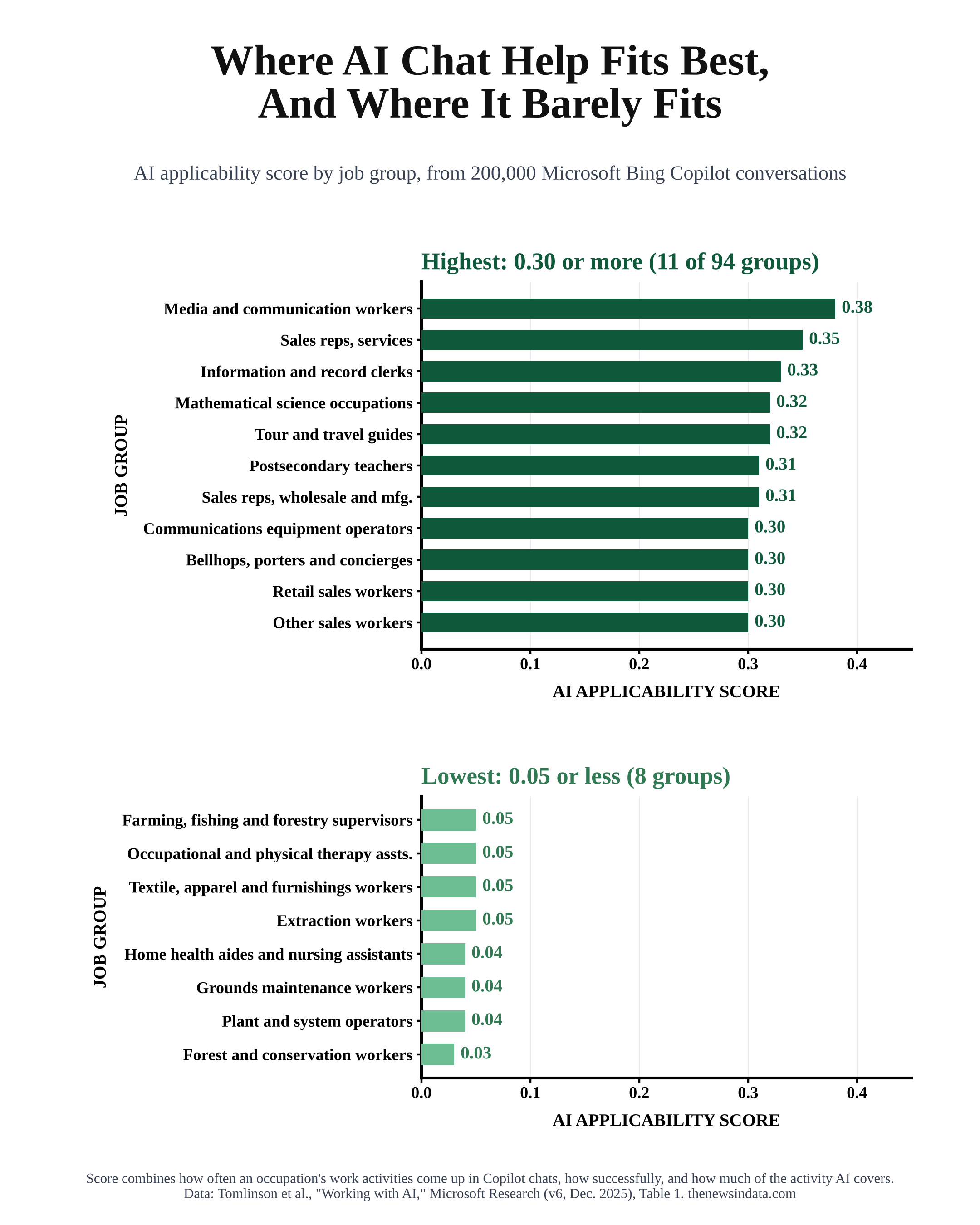
Teachers land in the middle: postsecondary teachers score 0.31 and elementary, middle and high school teachers 0.18. Search for any of the 94 job groups below.
Find Your Job Group
AI applicability score for 94 job groups, from Microsoft's study of Bing Copilot conversations. Higher means more of the group's work matches what people use AI chat for.
Scores range from 0.03 to 0.38 in this data. Source: Tomlinson et al., "Working with AI," Microsoft Research, Table 1 (v6, Dec. 2025).
Who works in the most exposed jobs
Workers in the top quarter of exposure earn about 47% more than workers with no exposure and are 16 percentage points more likely to be women. Graduate degree holders make up 17.4% of the most exposed group and 4.5% of the unexposed group.
Where the effect may be showing up
Unemployment in the most exposed jobs has tracked unemployment in jobs with no exposure. The one sign of change is among young workers: the rate at which 22- to 25-year-olds start jobs in highly exposed occupations has averaged 14% lower since ChatGPT's release than in 2022, a result the authors call barely statistically significant, with no similar drop for workers over 25. Stanford researchers have reported a 6% to 16% fall in employment for 22- to 25-year-olds in exposed occupations. The Bureau of Labor Statistics also projects slower growth through 2034 for more exposed jobs, about 0.6 percentage point less for every 10 points of exposure.


What the data can't tell us
Exposure measures where AI is being used, not whether a job will disappear; AI can also make workers more productive or change what a job involves. Anthropic's measure reflects how people used Claude in August and November 2025, and Microsoft's reflects Bing Copilot users, so neither captures all AI use. The 2023 task ratings may understate what newer models can do. Both studies come from companies that sell AI products.


How we counted: occupation figures are Anthropic's "observed exposure," the time-weighted share of an occupation's O\*NET tasks that are rated feasible for a language model and appear in work-related Claude usage, with fully automated use weighted 1 and assisted use 0.5. Job-group scores are Microsoft's AI applicability scores from Table 1 of "Working with AI" (version 6, December 2025). Sources: Anthropic, "Labor market impacts of AI," March 5, 2026; Tomlinson et al., Microsoft Research; Euronews, March 14, 2026.