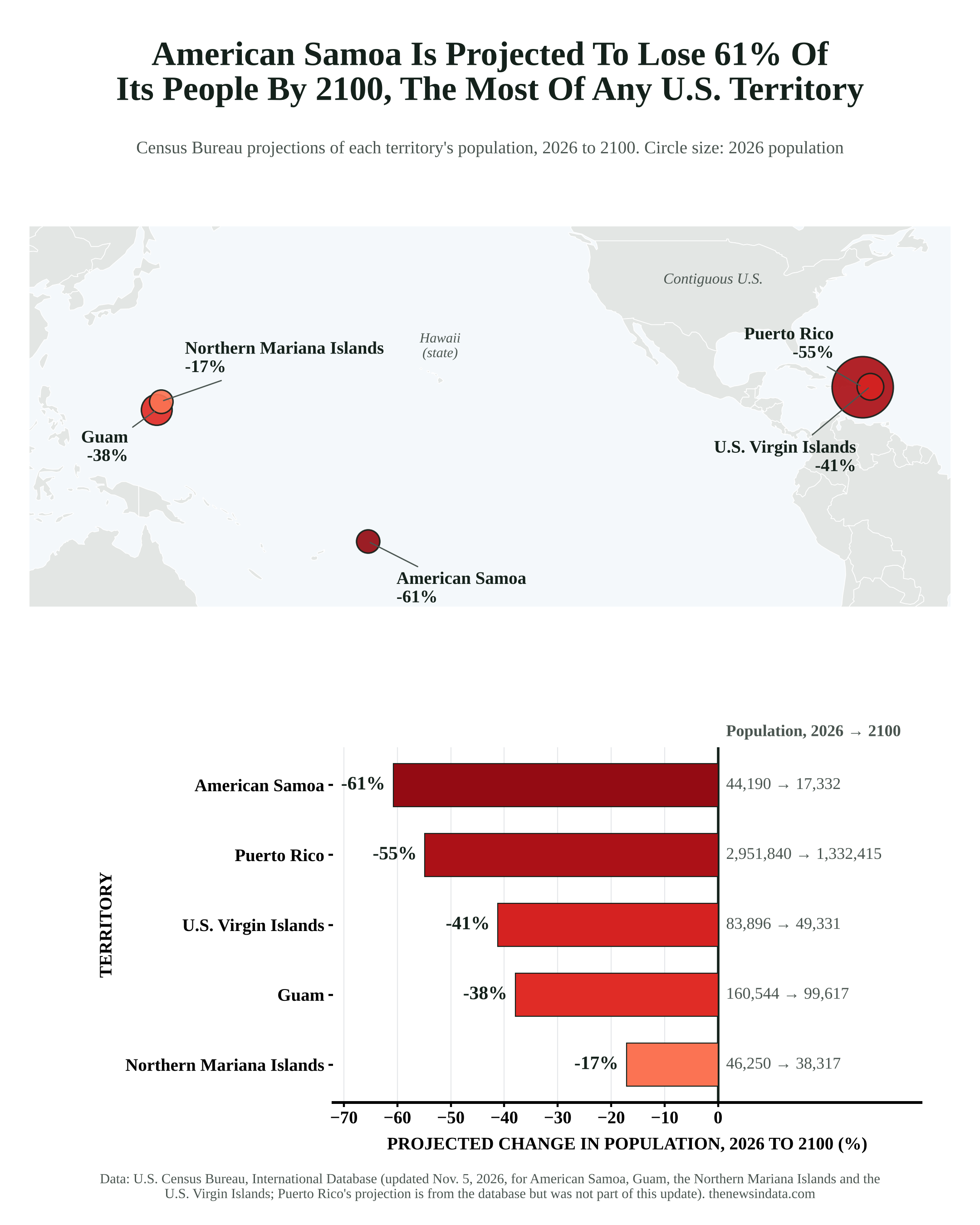
American Samoa is projected to lose about 61% of its people by 2100, falling from about 44,000 today to about 17,000, according to new Census Bureau projections released Nov. 5. Every U.S. territory is projected to shrink. The U.S. Virgin Islands would lose 41%, Guam 38% and the Northern Mariana Islands 17%. Puerto Rico, by far the largest territory, would lose 55% in the bureau's existing projection, which was not part of this update.
Fewer births, more departures
Two forces drive the decline, the Census Bureau said. Families are having fewer children: American Samoa's fertility rate fell from 4.0 children per woman in 2000 to 2.1 in 2026, about the level needed to keep a population steady without migration, and the Northern Mariana Islands' fell from 3.3 to 2.0 in roughly a decade. And people are leaving. In 2026, American Samoa lost the equivalent of 25 residents per 1,000 to net out-migration, and Guam lost 4.8 per 1,000.


Island by island
American Samoa had about 58,000 people in 2000. Guam is the only territory still growing for now, reaching about 161,000 in 2030 before beginning a long decline to about 100,000 by 2100. The Northern Mariana Islands fall more slowly, from about 46,000 to 38,000, because the bureau projects its fertility to level off.


The territories are also aging fast. In the U.S. Virgin Islands the median age is already 48.5, and in Puerto Rico it is 47.1. By 2100, the bureau projects median ages above 50 in every territory, compared with 31 in American Samoa today.
What could change it
Projections this far out are scenarios, not forecasts. The bureau assumes out-migration slows to zero by 2100. A change in jobs, military spending or migration rules could move these numbers a lot.


How we counted: Populations are midyear estimates and projections from the U.S. Census Bureau's International Database, read from its table tool on Nov. 6, 2026. American Samoa, Guam, the Northern Mariana Islands and the U.S. Virgin Islands were updated Nov. 5, 2026; Puerto Rico's projection is from the same database but was not part of this update. Percent changes compare 2026 with 2100. Census Bureau release. International Database. Download our data (CSV).