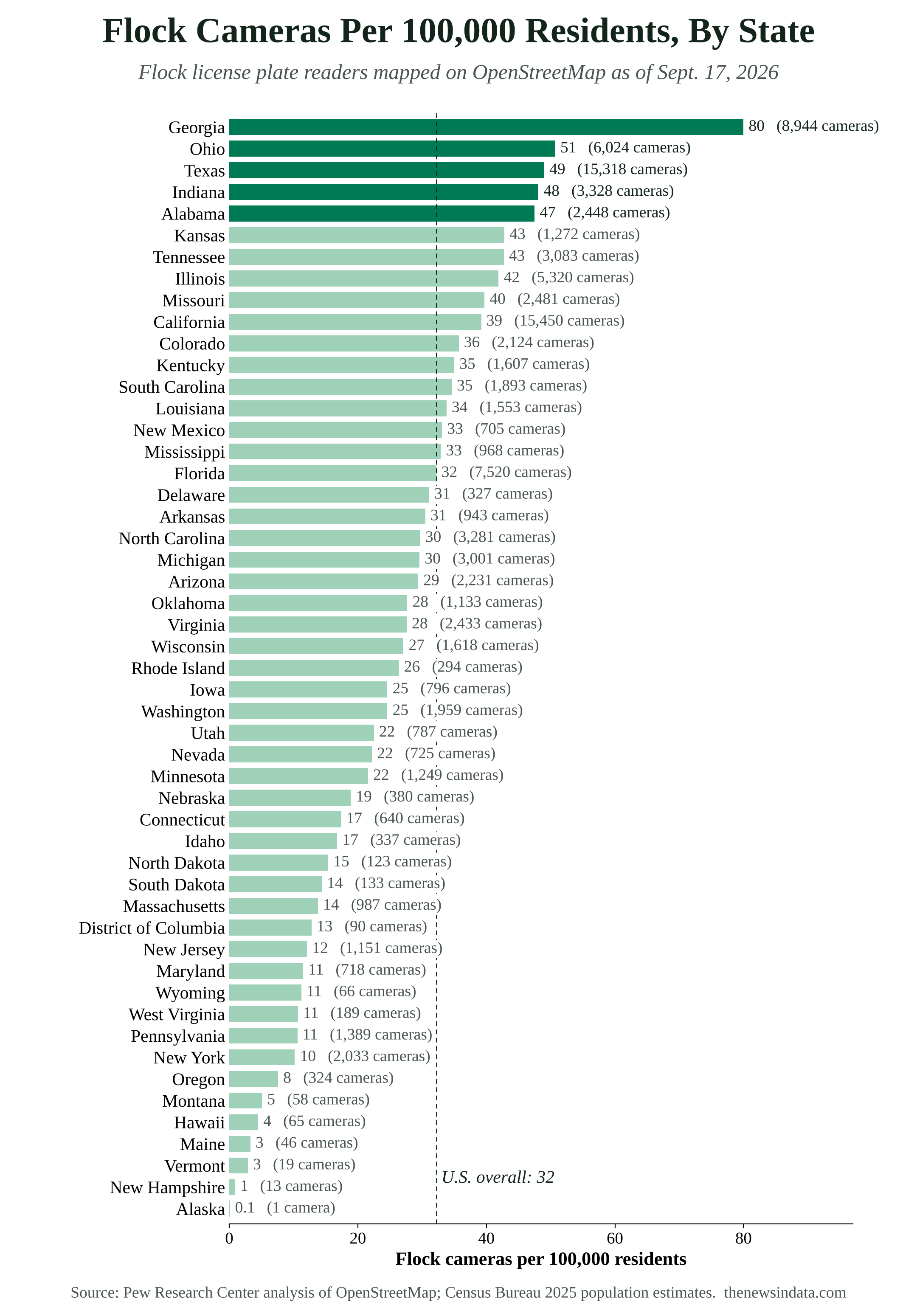
Flock Safety's license plate cameras now sit on poles in thousands of American towns, and how many your state has depends a lot on where you live. Georgia, where the company is based, has 80 of them for every 100,000 residents, according to a Pew Research Center analysis published Nov. 9. New Hampshire has one per 100,000 and Alaska has a single camera on the map.
The count comes from OpenStreetMap, a public map built by volunteers, because Flock does not publish where its cameras are. Pew found 109,577 Flock cameras on the map as of Sept. 17, 2026, which works out to 32 for every 100,000 people in the country.
In the map below, each dot is one camera per 100,000 residents. Tap a state for its numbers, or switch to total cameras to see where the hardware is.
Where the cameras are
After Georgia, the highest rates are in Ohio (51 per 100,000), Texas (49), Indiana (48) and Alabama (47). The lowest are in Alaska (0.1), New Hampshire (1), Maine (3), Vermont (3) and Hawaii (4). Much of the Northeast sits near the bottom, with New York at 10 and Pennsylvania at 11.


In raw numbers California and Texas lead with about 15,400 and 15,300 cameras. Those two plus Georgia, Florida and Ohio hold 53,256 cameras, or 49% of the total. Harris County, Texas, which includes Houston, has 3,490 on its own, more than 44 states have.
Roughly 80% of the cameras are in urban areas, Pew found. The Atlanta and Houston metro areas each have more than 4,000.
Why the true number is higher
The map is likely an undercount, since a camera only appears once a volunteer spots it and adds it. Flock told The Washington Post in August that it has more than 120,000 cameras in 6,000 communities, and a separate list kept by a private researcher runs as high as 175,000. Coverage by volunteers also varies from place to place, so a low count can mean few cameras or few mappers.


That matters most for the states at the bottom of the list. A state with one camera per 100,000 on the map almost certainly has few of them, but I would not read much into the gap between a state at 25 and one at 30.
What police departments disclose
Flock lets agencies publish a transparency portal, and Pew looked at the 1,517 that had one as of Sept. 21. Nearly all of them say how long they keep the data (96%), how many cameras they have (93%) and how many searches they have run (90%). Two-thirds say whether they share data with other organizations, and half give any detail about individual searches.
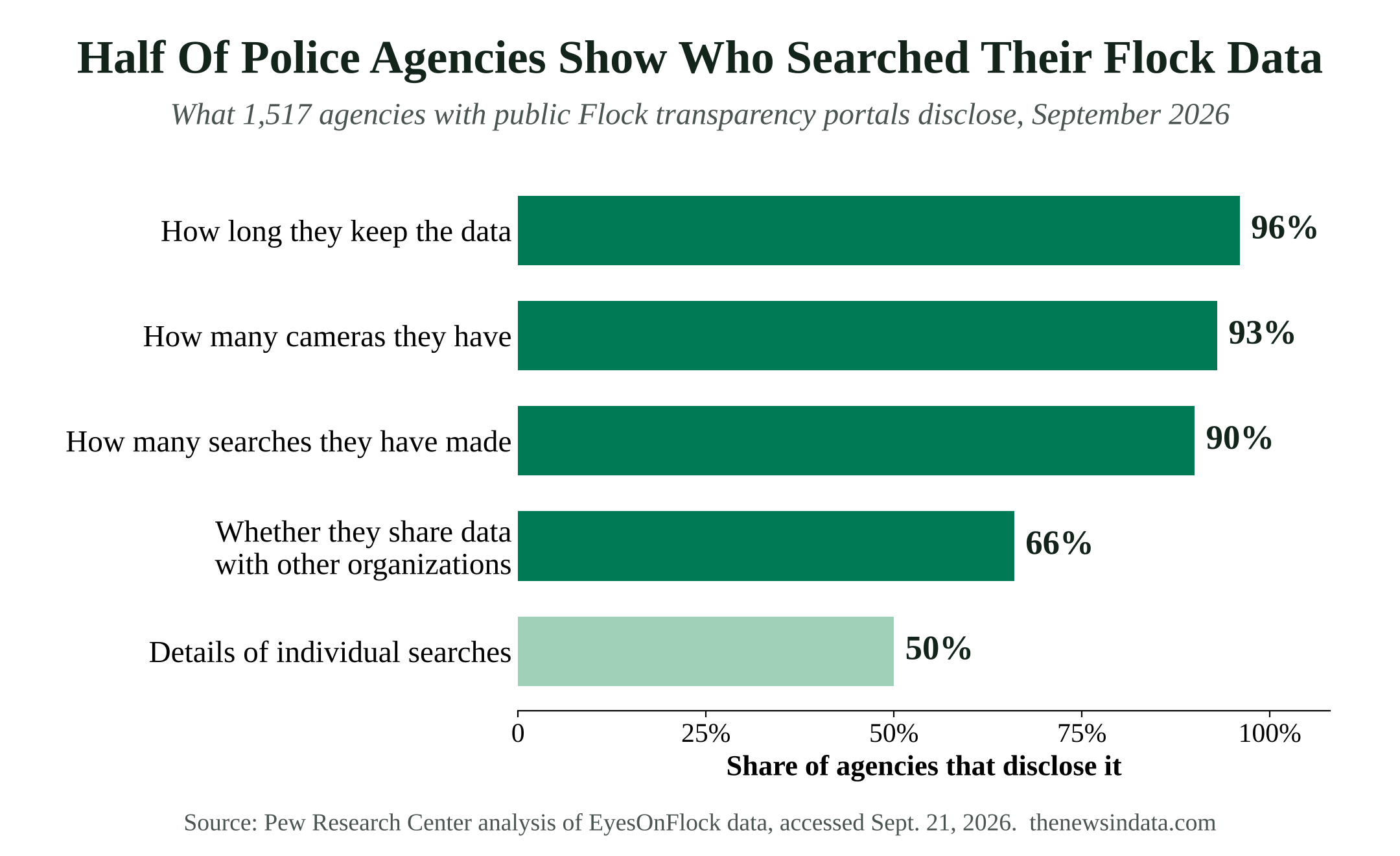
The typical agency with a portal has 12 cameras and keeps its data for 30 days. That was Flock's default retention period until August, when the company lowered it to seven days. Agencies that disclose sharing report a median of 217 other organizations with access, mostly other police departments.
The portals cover a minority of the cameras. Together those 1,517 agencies list 39,465 cameras, or 36% of the ones on the map.
What this can't tell us
These numbers show where the cameras are, and they can't show whether the cameras reduce crime. Flock says its cameras helped with more than 1 million investigations in 2025, a company figure that hasn't been independently checked. Critics point to reported cases of officers misusing searches, and some members of Congress have proposed limits or a ban. Supporters and opponents are largely arguing about the same fact, which is that a networked camera can reconstruct where a car has been.


A high rate doesn't say who owns the cameras either. Police departments, homeowner associations and businesses all buy them, and the map lists an owner for only 12% of cameras.
How we counted: All figures come from Pew Research Center's Nov. 9, 2026, analysis. Camera counts are OpenStreetMap entries tagged as Flock Safety license plate readers, accessed Sept. 17, 2026 (109,577 in all), divided by Census Bureau 2025 population estimates. Rates in the charts are Pew's rounded figures; the 32 per 100,000 national rate is our calculation from Pew's state counts and populations. Portal figures are Pew's analysis of 1,517 agencies tracked by EyesOnFlock, accessed Sept. 21, 2026. In the interactive's total view, each dot is 200 cameras. Pew Research Center. Download our data (CSV).