Watching NBA games, I kept noticing that the team that builds the first real lead, say six points or more, seems to win most nights. I wanted to know whether that holds up, so I went through the play-by-play of all 6,150 regular-season games from 2021–22 through 2025–26. The hunch has merit, but six points is too small a cushion. The first team to lead by six won 63% of the time, while the first team to lead by 10 won 74%.
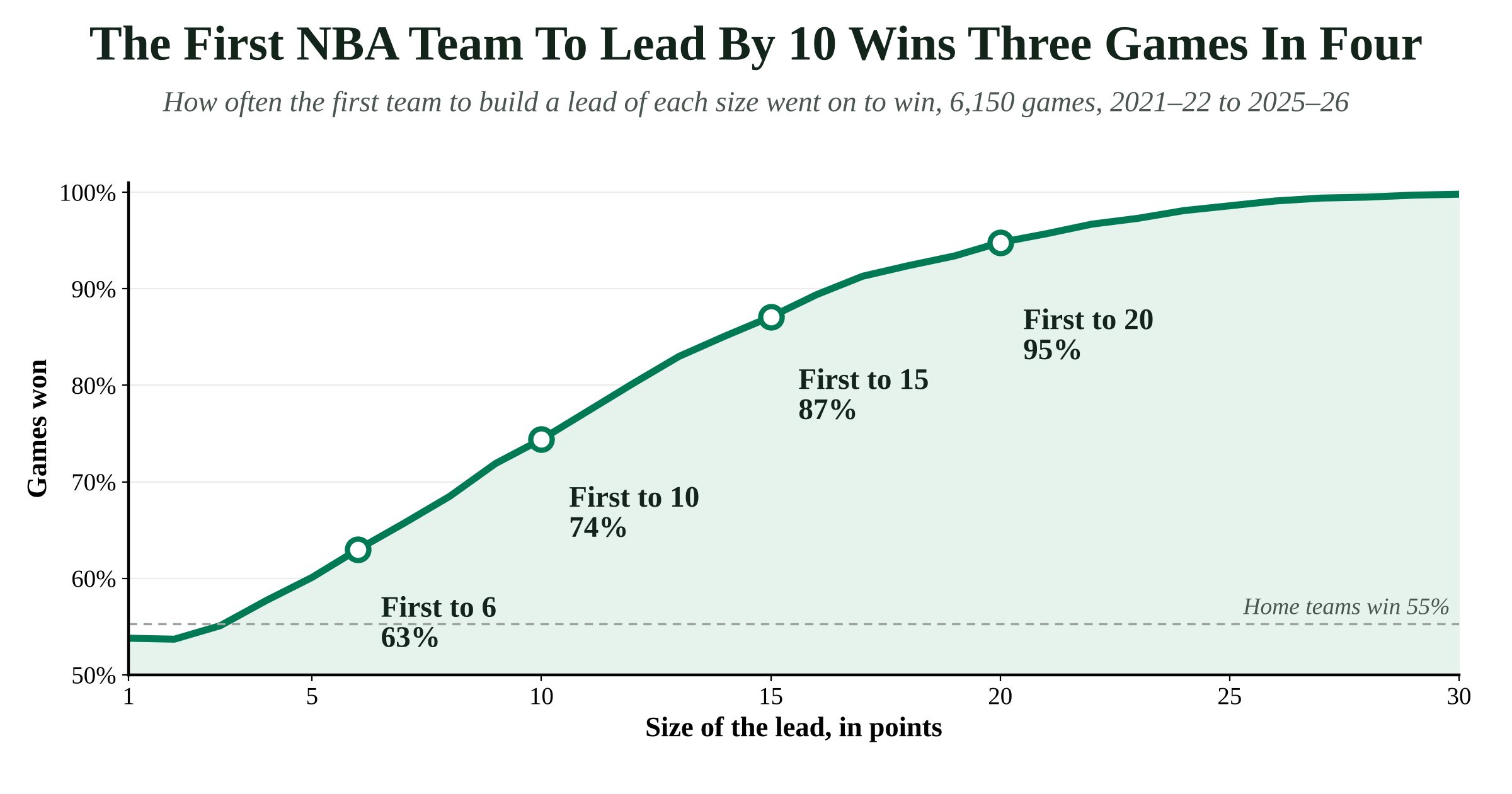
For comparison, home teams won 55% of those games and the team that scored the first basket won 54%. A six-point lead is better than home court, though it still gets erased in more than one game out of three.
How big does the lead have to be?
Every one of the 6,150 games had a six-point lead at some point, and half of them had one within the first 4 minutes and 20 seconds. Each extra point of cushion after that adds about 3 percentage points to the leader's chances. The first team up by 12 won 80% of the time, the first team up by 15 won 87%, and the first team up by 17 won 91%.
Bigger leads are safer and rarer. A 20-point lead held up 95% of the time, but only 46% of games had one. To reach 99% a team needed to lead by 26, which happened in 23% of games.


When the lead comes matters as much as its size
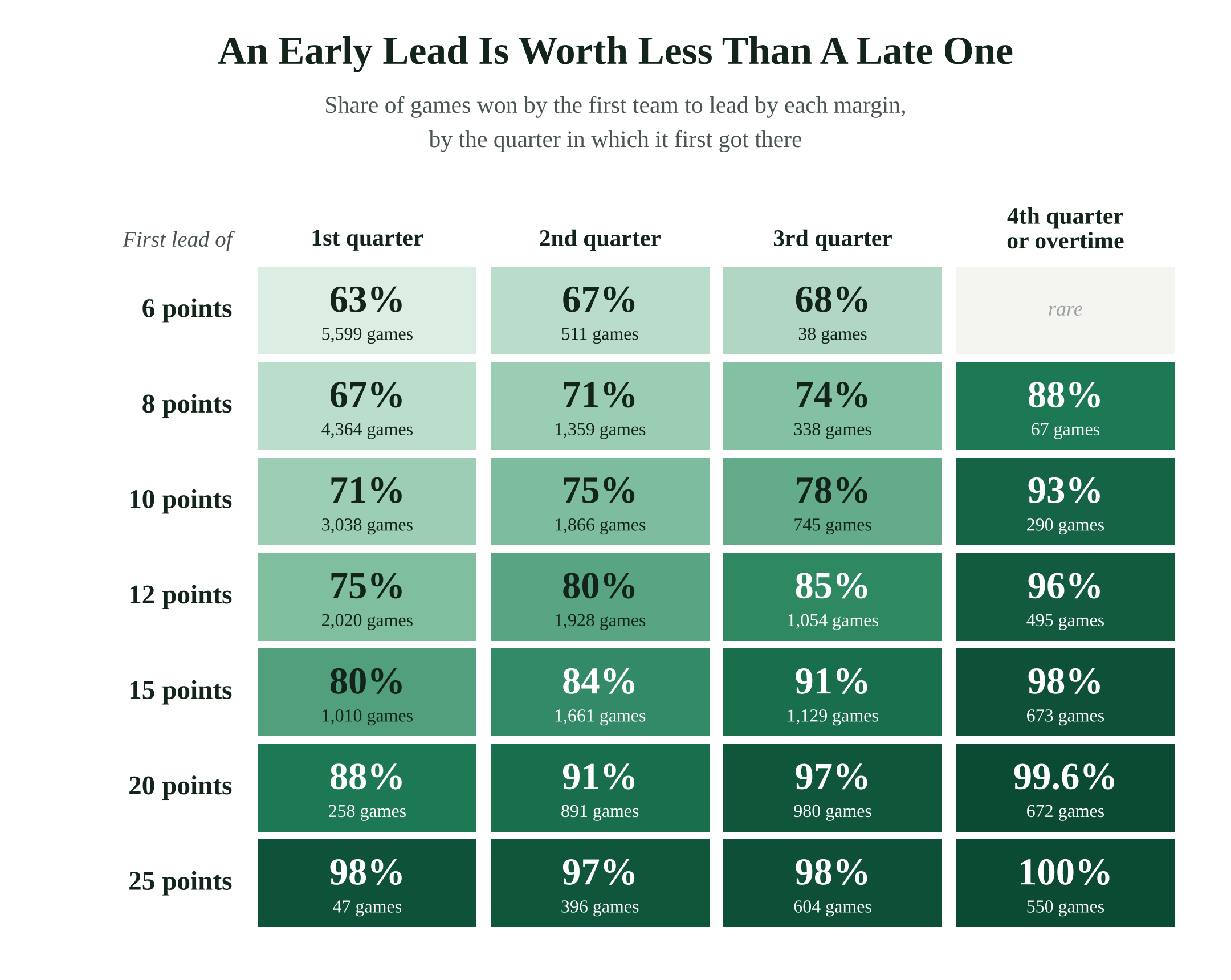
A 10-point lead in the first quarter is a weaker signal than the same lead late. Teams that first went up by 10 in the first quarter won 71% of those games, compared with 78% for teams that first got there in the third quarter and 93% for those that got there in the fourth quarter or overtime. The same pattern holds at 15 points, where a first-quarter lead won 81% and a fourth-quarter lead won 98%.
Who builds the lead matters too. A home team that was first to six won 67% of the time, compared with 58% for a road team. At 10 points the split was 77% to 71%.
Try it yourself
Slide to any lead from 1 to 30 points, then pick the quarter in which the first team got there or whether it was at home.
No lead is completely safe
Seven games in five seasons were won by a team that trailed by 27 or more. The largest comeback belonged to the Los Angeles Clippers, who trailed the Washington Wizards by 35 points on Jan. 25, 2022, and won 116–115. The Atlanta Hawks erased a 30-point deficit against the Boston Celtics on March 25, 2024, and won 120–118.
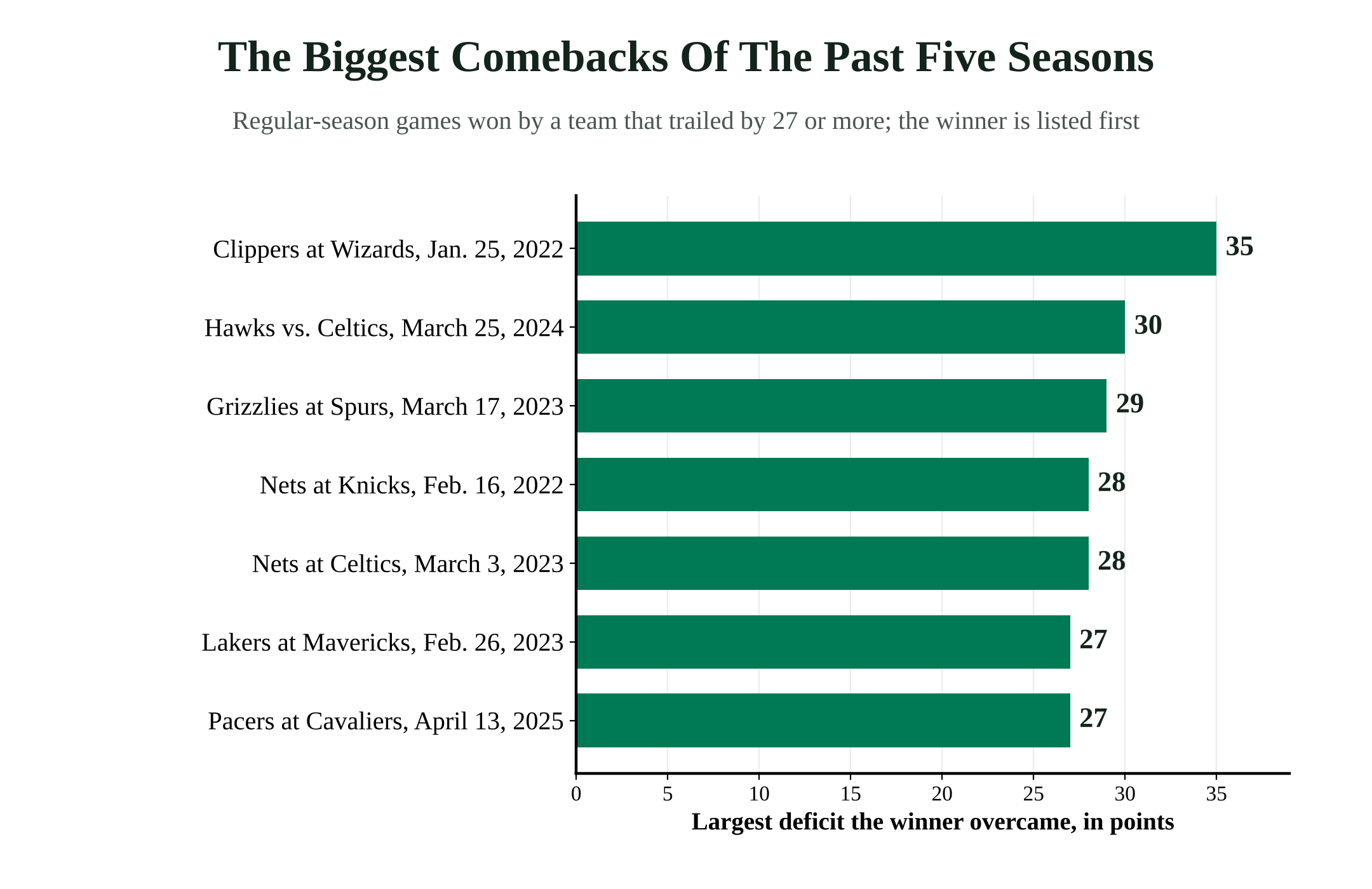
Even at 30 points the record was 861 wins and two losses, so the two losers above are the entire list.


What this can't tell us
A lead is partly a head start and partly a sign of which team is better, and this count can't separate the two. Good teams build early leads more often, so some of that 74% reflects team quality instead of the lead itself. The figures also cover the regular season only, and playoff games between closely matched teams may behave differently. The results were steady from year to year, with the first team to 10 winning between 73% and 75% in each of the five seasons.
How we counted: We read the NBA's official play-by-play feed for every regular-season game from 2021–22 through 2025–26 (6,150 games). For each lead size from 1 to 30 points, we found the first moment either team led by at least that many, noted the team, the quarter and whether it was at home, and checked whether that team won. Leads first reached in overtime are grouped with the fourth quarter. Percentages are shares of the games in which a lead of that size occurred: all 6,150 games had a six-point lead, 5,939 had a 10-point lead, 4,473 had a 15-point lead and 2,801 had a 20-point lead. Comeback sizes are the largest deficit the winning team faced at any point. Source: NBA.com play-by-play and box score data. NBA.com. Download our data (CSV).