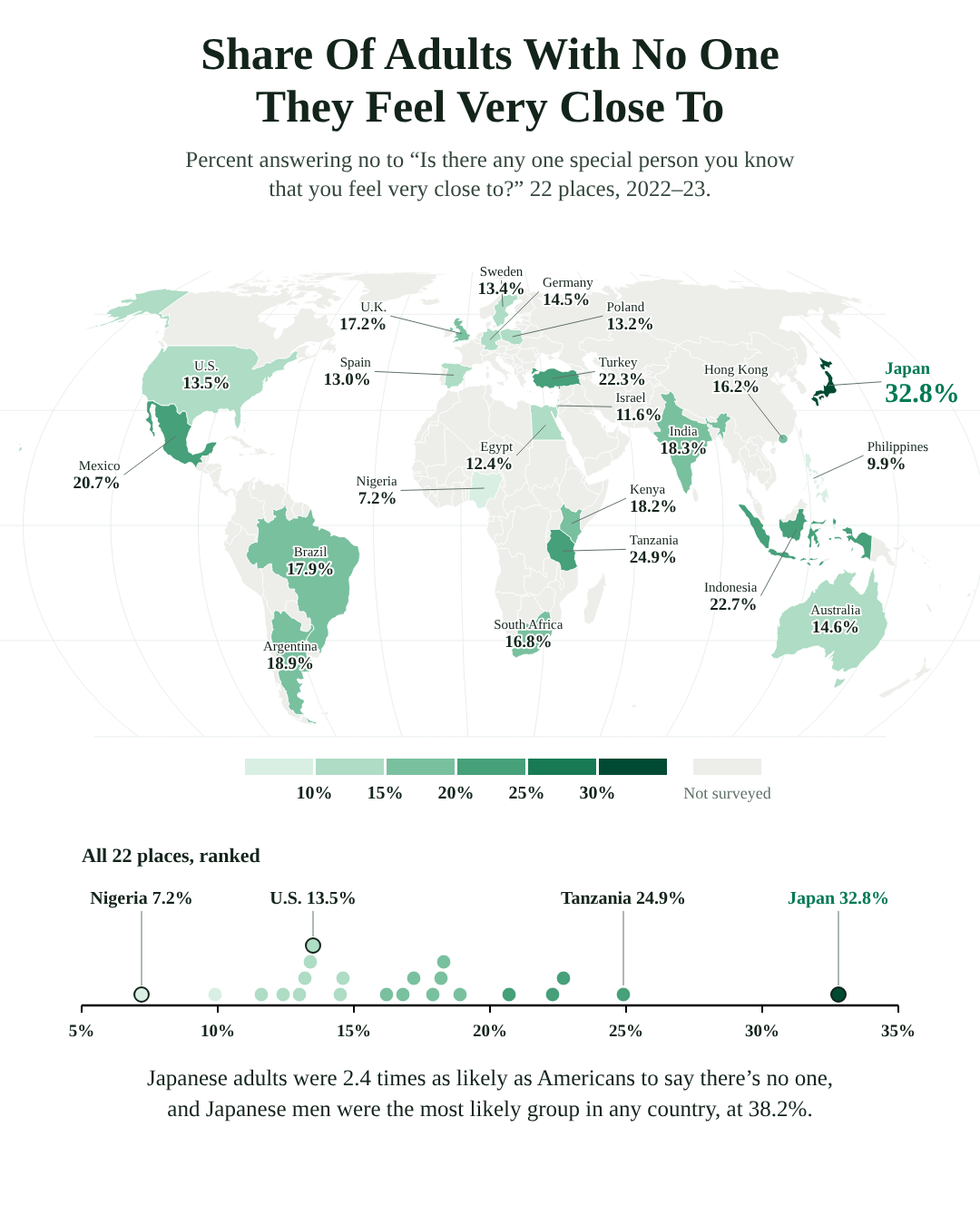
I went looking for the loneliest country in the Global Flourishing Study's newly opened data and kept landing on Japan. The survey asked people in 22 countries whether “there's any one special person you know that you feel very close to,” someone you can confide in, and 32.8% of Japanese adults said no. That is 2.4 times the U.S. share of 13.5% and about twice the 16.5% in the median country.
[Samuel: one sentence on why you looked at this, e.g. something you've seen in students, athletes or friends.]


Who else said there's no one?
Tanzania was next at 24.9%, followed by Indonesia at 22.7% and Turkey at 22.3%, so the second-place country sits 7.9 points below Japan. At the other end, 7.2% of Nigerians and 9.9% of Filipinos said there's no one, which makes a Japanese adult about 4.5 times as likely as a Nigerian to give that answer. Indonesia is worth a second look, since it ranks first in the study on overall flourishing even though more than one in five Indonesians said there's no one they feel very close to.
Middle-aged Japanese men answered no most often
Japanese men were the most likely group to say there's no one, at 38.2%, compared with 27.7% of Japanese women. That 10.5-point gap is the widest of the 22 countries, and men answered no more often than women in 19 of them. In Japan the share peaked among adults 30 to 49, at 36.7%, and was lowest among those 65 and older, at 27.6%. The U.S. runs the other way, with 17.4% of adults 18 to 29 saying there's no one, compared with 11.7% of those 65 and older.


Does having someone close go with feeling less lonely?
It does in 21 of the 22 countries, though the gap varies. The survey separately asked how often people feel lonely, on a scale from 0 (always) to 10 (never). Japanese adults with someone close averaged 6.54, and those without averaged 4.79. In the U.S. the figures were 6.99 and 4.81, nearly the same gap. In Nigeria the two groups both averaged 6.78, so there, having no one special didn't go with more loneliness at all. These are averages from one survey, so they show which things go together, not what causes what.
Was it a one-year blip?
The study went back to many of the same people a year later, in 2023 and 2024, and 32.7% of Japanese adults said there's no one, essentially the same as the 32.8% the year before. The U.S. share moved from 13.5% to 12.4%, and Nigeria's from 7.2% to 11.2%.


What the data can't tell us
People in some countries answered online and others by phone or in person, and people tend to admit to things like having no close friend more readily online. Japan's survey was online, but so were those in the U.S., Britain, Germany, Sweden, Spain, Australia, Poland and Hong Kong, and the highest of those after Japan was Britain at 17.2%, so the method doesn't explain the gap. The question was also translated into about 40 languages, and “special person” may carry a different weight in Japanese than in English. The study's third wave, with new findings on relationships and belonging, will be presented on Dec. 2, and I'll check whether Japan's number holds.
Notes and calculations
Ratio to the U.S.: 32.8 divided by 13.5 is about 2.4. Ratio to the median: 32.8 divided by 16.5 is about 2.0.
Japan vs. Nigeria: 32.8 divided by 7.2 is about 4.6, rounded down to “about 4.5 times” in the text.
Gender gap in Japan: 38.2 minus 27.7 is 10.5 points; the next widest is Turkey, 26.5 minus 17.9, or 8.6 points.
Median: the middle of the 22 country figures falls between 16.2% (Hong Kong) and 16.8% (South Africa), at 16.5%.
We reproduced the study's published country flourishing scores from the same file to within 0.02 points before computing anything new.
How we counted: Global Flourishing Study Waves 1 and 2 public data file (gfs_all_countries_wave2.csv), downloaded Nov. 2, 2026. Wave 1 was collected from April 2022 to December 2023 and Wave 2 a year later. Shares are weighted with the study's cross-sectional weights (ANNUAL_WEIGHT_C1 for Wave 1, ANNUAL_WEIGHT_C2 for Wave 2) and exclude people who skipped, didn't know or refused. 207,018 Wave 1 respondents answered the question across the 22 countries (counting Hong Kong as one). Mainland China, added in 2024, is left out. Age bands use age at Wave 1. Loneliness averages use the 0–10 “How often do you feel lonely?” item. Survey mode is from the study's MODE_ANNUAL code. Sources: Global Flourishing Study, Waves 1 and 2 open data (Center for Open Science); VanderWeele et al., “The Global Flourishing Study: Study Profile and Initial Results on Flourishing,” Nature Mental Health, April 30, 2025.