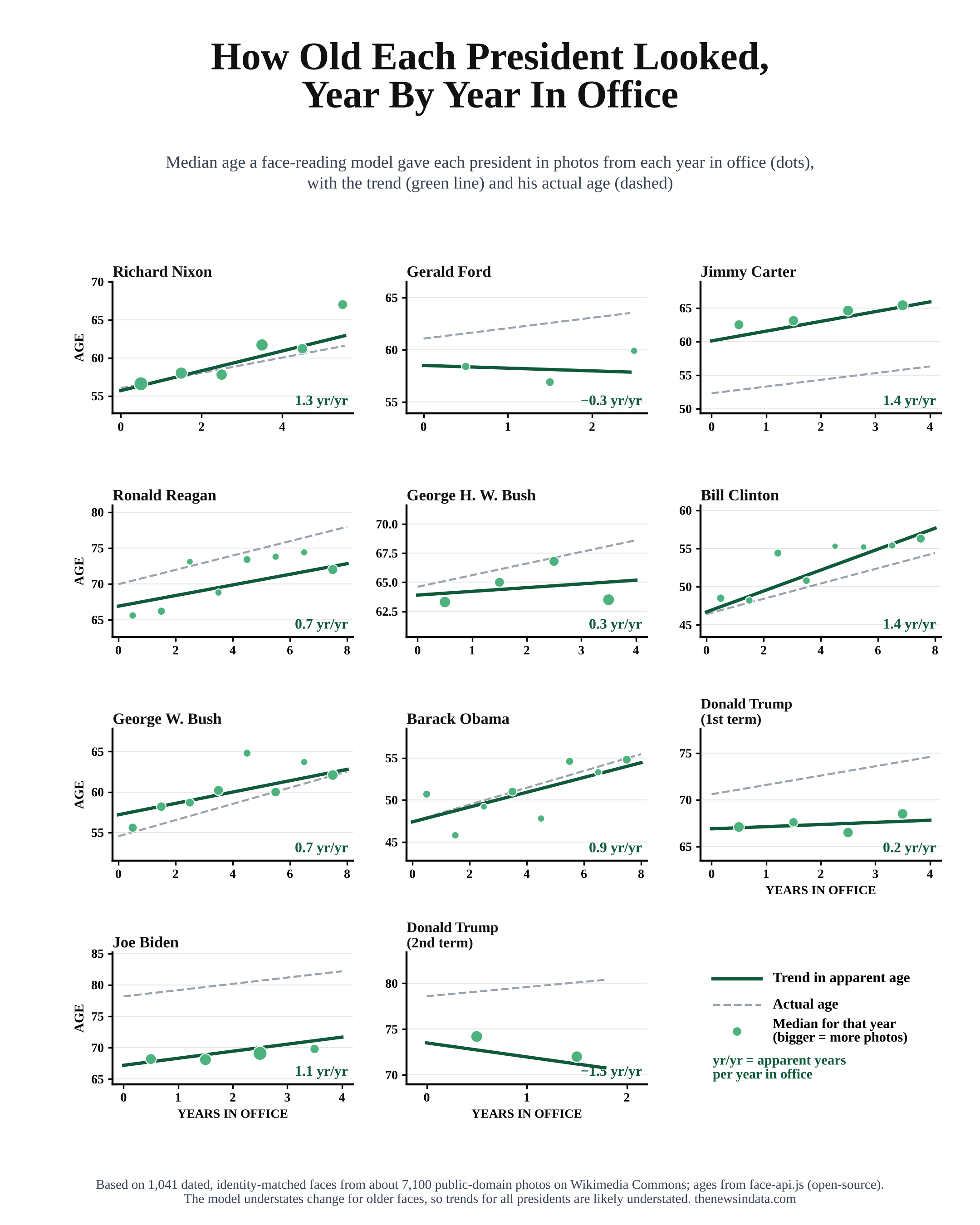
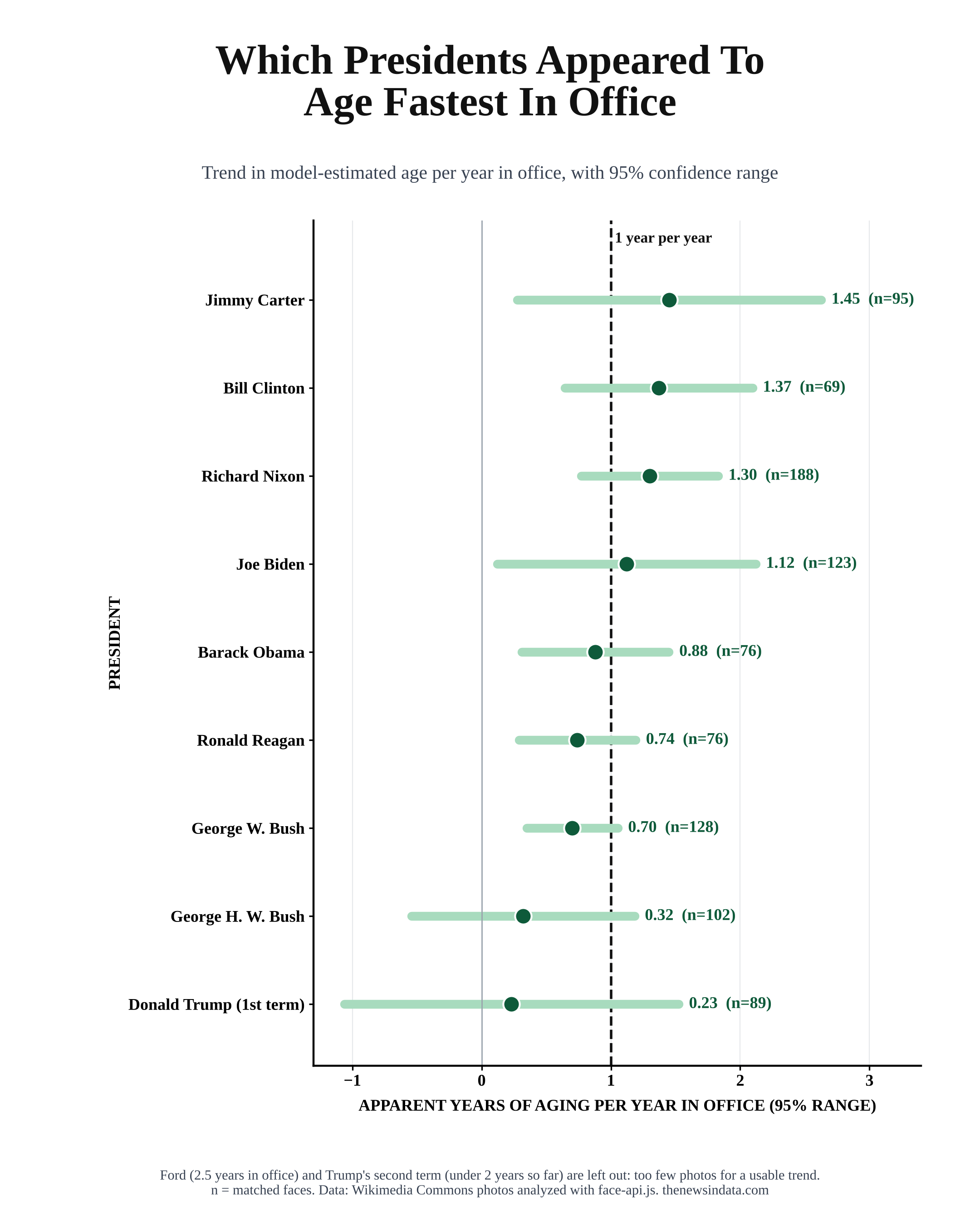
We ran an open-source face-reading model over about 7,100 public-domain photos of the 10 presidents from Richard Nixon to Donald Trump and tracked how old each one looked as his time in office went on. Jimmy Carter's apparent age rose 1.45 years for every year he served, Bill Clinton's 1.37 and Nixon's 1.30, the fastest of the group. George W. Bush (0.70), George H. W. Bush (0.32) and Trump in his first term (0.23) changed the least, though the estimates for several presidents are uncertain.
How we measured it
For each president we gathered his dated photos on Wikimedia Commons, most of them official White House and presidential library photos, from shortly before he took office through the end of his term. The model found every face in each photo, compared it with the president's official portrait to pick out the president and skip aides and crowds, and estimated his age. We kept 1,250 faces that clearly matched and were large enough to read, 1,041 of them taken while the man was in office, and fit a trend line to each presidency: how many years the model's estimate rose for each year in office. One year per year would mean a president looked his age the whole way through.
Nixon's last year
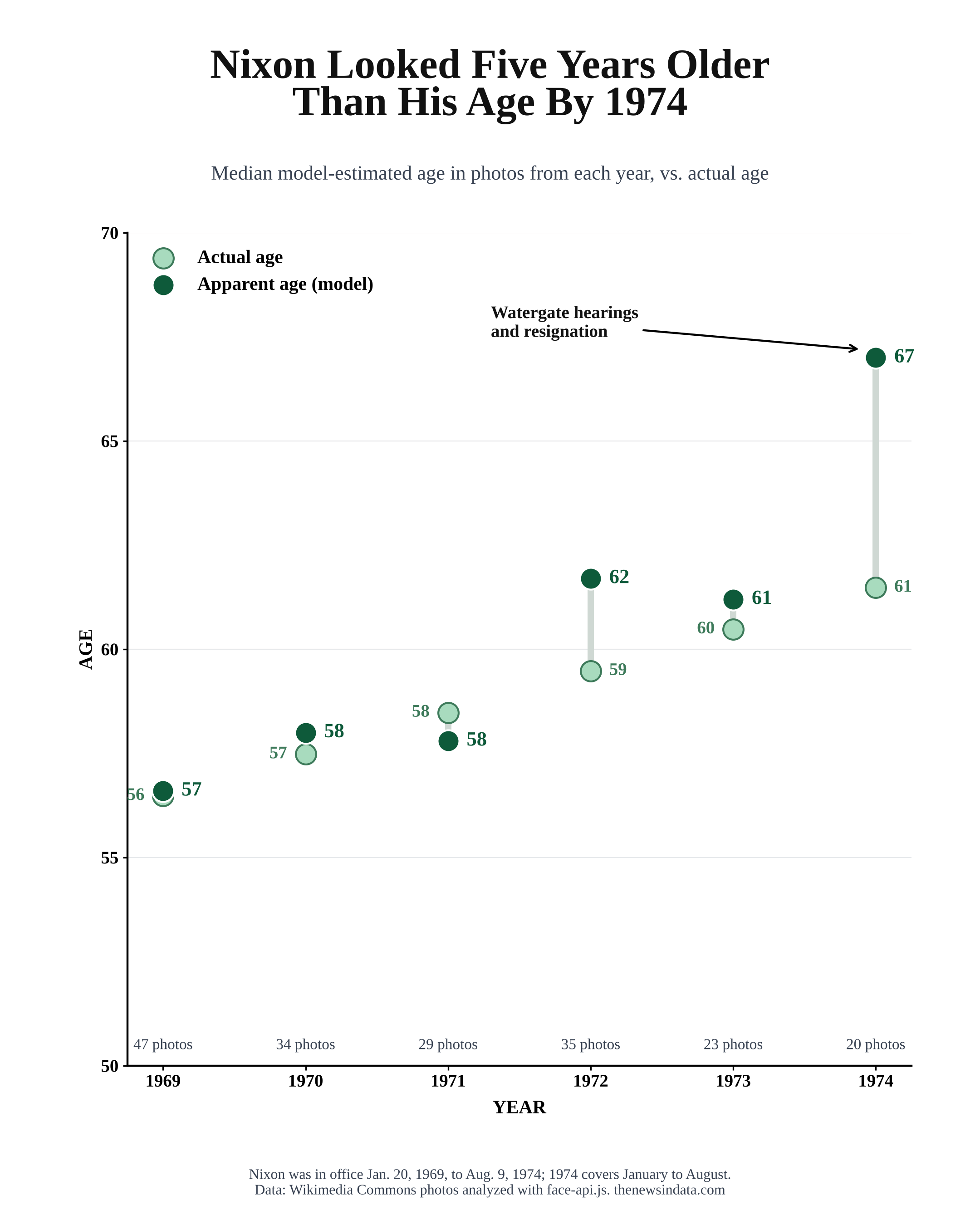
The model put Nixon at 57 in his 1969 photos, close to his actual age of 56, and it tracked his real age through 1971. It then pulled ahead: 62 in 1972, when he was 59, and 67 in photos from January to August 1974, the months of the Watergate hearings and his resignation, when he was 61.
100 dated photos of Nixon from Wikimedia Commons (public domain), with the face the model matched to Nixon boxed and its age estimate. Model: face-api.js.
Who appeared to age fastest
Carter, Clinton and Nixon top the list, followed by Joe Biden at 1.12 apparent years per year. Barack Obama (0.88), Ronald Reagan (0.74) and George W. Bush (0.70) aged more slowly than the calendar by this measure. Gerald Ford's 2.5 years in office and Trump's current term, under two years old, produced too few usable photos for a trend.


How sure we are
Not very, for any one president. The 95% ranges are wide: Carter's runs from about 0.3 to 2.6 years per year, and Trump's first term from below zero to 1.5. Seven of the nine ranges sit above zero, but none is clearly above one year per year; Nixon's, from 0.8 to 1.8, comes closest. The model also compresses age: across all 1,250 faces, its estimate rose only about 0.57 years for each year of actual age, and it read older presidents as younger than they were, putting Biden at about 68 in his first year in office, when he was 78. That means the trends above probably understate how much every president's face changed.
What changed since 2016
Our 2016 version of this story used a consumer age-guessing website and about three photos per president for four presidents. It found Clinton aging at 2.9 years per year, George W. Bush at 1.7, Obama at 1.1 and George H. W. Bush at 1.0. With hundreds of photos per president, the ranking holds at the top, with Clinton fastest of those four, but every rate is lower.


What the data can't tell us
A face model reads skin, hair and expression in a photo, not health or biological age. Lighting, makeup, camera technology, and which moments White House photographers chose to shoot and archive all affect what it sees, and the mix of black-and-white and color photos changes over the decades. Photos dated only by year were placed at midyear.
How we counted: photos are from Wikimedia Commons categories for each president by year (about 500 photos per president, plus a second batch from the years in office for Ford, George H. W. Bush, Trump and Biden). Faces were detected, matched and aged with face-api.js 1.7.13 (SSD MobileNet v1 detector, FaceNet-style recognition, age-gender model) running in a web browser. A face counted as the president if its descriptor was within 0.55 of his official portrait's and at least 50 pixels wide. Trends are ordinary least-squares fits of estimated age on years since inauguration; ranges are 1.96 standard errors. Sources: Wikimedia Commons; face-api.js; our 2016 story.