Updated 5:20 p.m. Eastern on Nov. 13, 2026 · The ground stop is still in effect · See live flights on Flightradar24 ›
The Federal Aviation Administration halted every departure in the United States at 3:54 p.m. Eastern on Friday, Nov. 13, the third nationwide ground stop in the agency's history and the first to begin after noon. The earlier two started at 9:25 a.m. on Sept. 11, 2001, and at about 7:30 a.m. on Jan. 11, 2023.
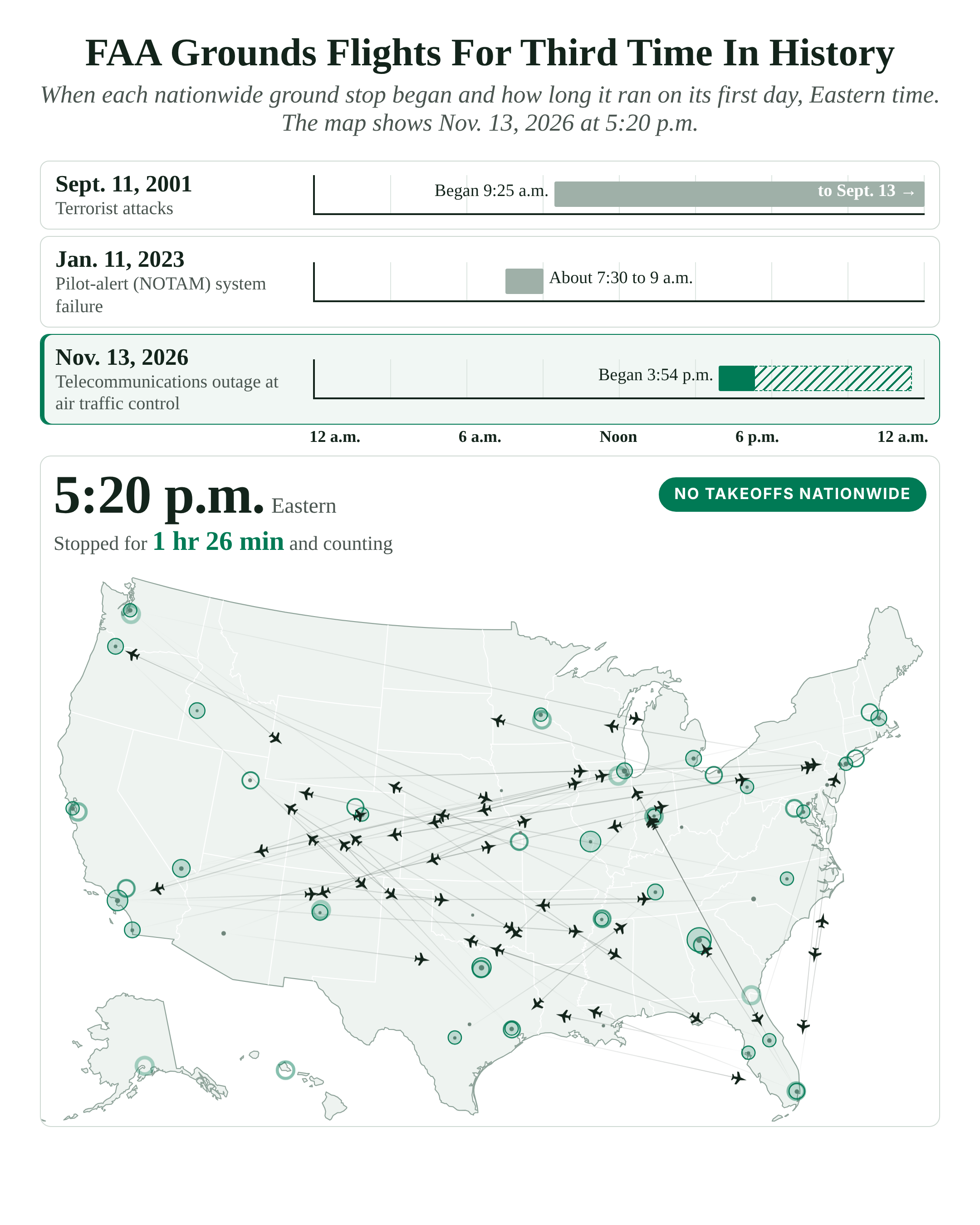
As of 5:20 p.m. Eastern on Friday the stop was still in effect, 1 hour and 26 minutes after it began. The FAA's advisory ran through 11:30 p.m., though the agency told airlines to hold departures until further notice, so that time is a planning window that can move in either direction. FlightAware had counted more than 9,000 delays for the day by then. Reports of its cancellation count between 5 and 5:20 p.m. ranged from about 450 to more than 700, so we are treating 450 as the floor.
Pick one of the three days above and press play to watch it unfold. Each plane on the map stands for roughly 25 aircraft, and the positions are illustrative.
What happened on Friday
The trouble showed up first in Chicago. At about 3:10 p.m. Eastern the FAA stopped flights bound for O'Hare over communications problems, and Midway followed three minutes later. The nationwide order came about 44 minutes after the first Chicago stop.
A ground stop holds planes at their departure airports while flights already in the air keep going. More than 3,100 flights were airborne when Friday's order went out, according to TheStreet, and they were allowed to continue to their destinations. That is the main difference from 2001, when the FAA ordered all 4,546 aircraft then in the sky to land at the nearest airport.


The FAA first said the stop followed communication issues at "multiple" air route traffic control centers, the facilities that handle flights between airports (20 in the lower 48 states plus Alaska and Hawaii), while Transportation Secretary Sean Duffy said the issue affected all of them. About an hour later the agency called it a temporary telecommunications outage and said it had halted flights out of caution.
How the three stops compare
The 2001 stop is the only one that emptied the sky. Takeoffs were banned at 9:25 a.m., every aircraft was ordered down at 9:45 a.m., and by 12:16 p.m., 2 hours and 31 minutes later, the airspace over the lower 48 states was clear. Commercial flights were not allowed again until 11 a.m. on Sept. 13, about two days later.
The 2023 stop was far shorter. A failure in the system that sends safety notices to pilots led the FAA to pause domestic departures for about 90 minutes on a Wednesday morning. Even so, FlightAware counted more than 1,300 cancellations and about 10,000 delays that day.
Friday's stop had already run 86 minutes by 5:20 p.m., nearly as long as the entire 2023 stop, and it began late on a Friday afternoon where the 2023 stop began early on a Wednesday. The more than 9,000 delays FlightAware counted by 5:20 p.m. were already close to the roughly 10,000 logged for the whole day in 2023, and Friday's count was still rising.
What about 2020
The pandemic emptied airports more thoroughly than any ground stop, yet the FAA never issued a nationwide one. Airlines cut their own schedules while the airspace stayed open. The Transportation Security Administration screened 87,534 people on April 14, 2020, which was 96% fewer than the 2.2 million on the same weekday a year earlier.
What is not known
The FAA has not said what caused the telecommunications outage. Homeland Security Secretary Markwayne Mullin said there was no indication of a threat to the country and that the outage was separate from a global Microsoft outage one day earlier. CNN reported that two law enforcement officials said preliminary reports indicate it was not a cyberattack.
Three days before the stop, on Nov. 10, the FAA expanded SMART, an AI tool that suggests flight reroutes, to all 22 centers. No official has connected the tool to the stop, Mullin said he could not confirm whether the two are related, and no reporting so far shows a link.
This story reflects what was known at 5:20 p.m. Eastern on Nov. 13, 2026. We will update the end time, the cause and the final delay counts as the FAA and FlightAware report them.
How we counted: Start times for Nov. 13, 2026 come from the FAA command center advisory as reported by Gizmodo, TheStreet and ABC News; Friday's delay and cancellation counts are FlightAware's as reported by MS NOW and CBS News, and they cover the whole day, including delays from before the stop; and officials' statements are from CNN and Colorado Public Radio. The 2023 times are approximate, since reports differ by about 10 minutes on the start; cancellation and delay counts are FlightAware's, as reported by NPR. The 2001 timeline is from the FAA's historical chronology, and the airborne counts between 9:29 a.m. and 12:16 p.m. are from a published compilation of FAA figures. The 2001 count covers all aircraft and the 2026 figure covers flights, so the two are not directly comparable. On the map, planes fly made-up routes between 42 large airports; only the 2001 plane count follows real data. Daily screening figures are from the TSA. Download our data (CSV).