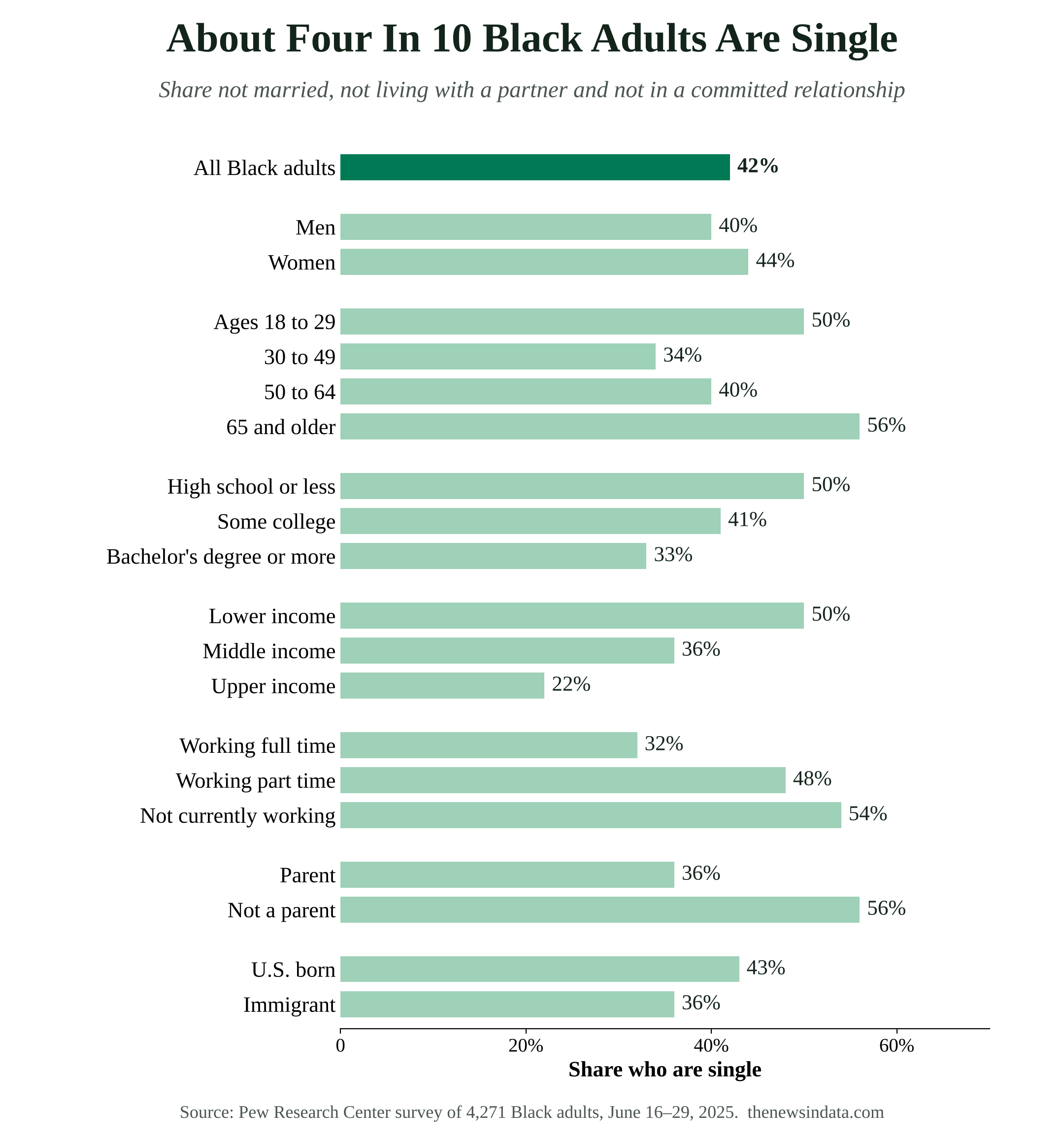
About four in 10 Black adults in the U.S. are single, and roughly half of them are looking for a relationship or dates. A Pew Research Center report published Nov. 12 asked those singles what they want in a partner, what would rule someone out and why they think they are single.
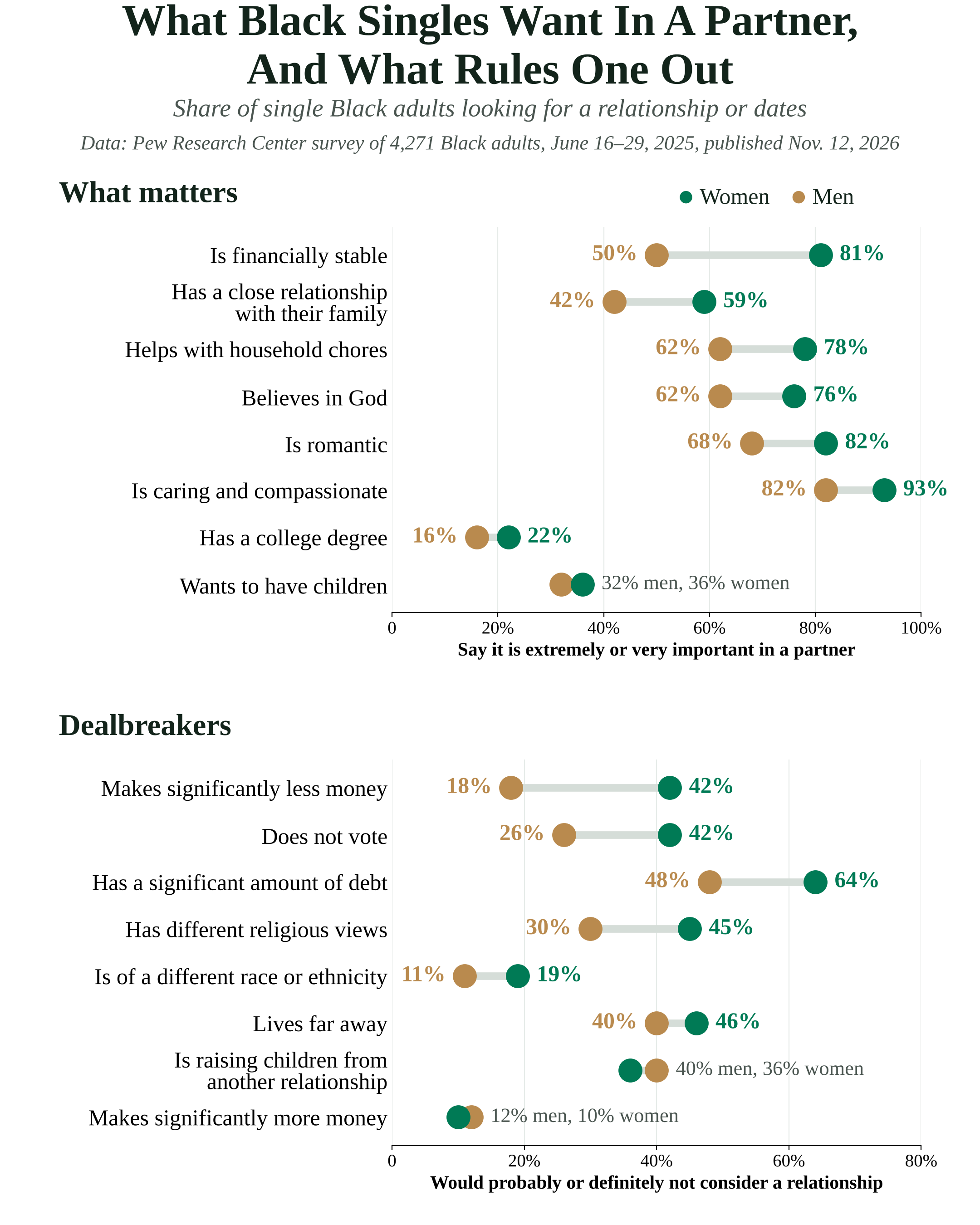
Men and women put the same things at the top of the list: a partner who is caring and compassionate, and one who is romantic. The widest gap is over money. Among those looking, 81% of women and 50% of men say it is extremely or very important that a partner is financially stable.
Use the tabs below to compare women's and men's answers on what they want, their dealbreakers and why they are single.
How many are single, and how many are looking
Pew counts someone as single if they are not married, not living with a partner and not in a committed relationship. By that definition 42% of Black adults are single, compared with 29% of other U.S. adults. Black women (44%) and men (40%) are about equally likely to be single.


Being single is most common at the two ends of adult life, 50% of those 18 to 29 and 56% of those 65 and older, and among Black adults with lower incomes (50%, compared with 22% of those with upper incomes).
Among Black singles, 53% are looking for a relationship or dates. That is higher than among White singles (36%) and about the same as among Hispanic singles (49%, from a small sample). Single Black men are more likely to be looking than single Black women, 60% to 47%.
Women more often want commitment
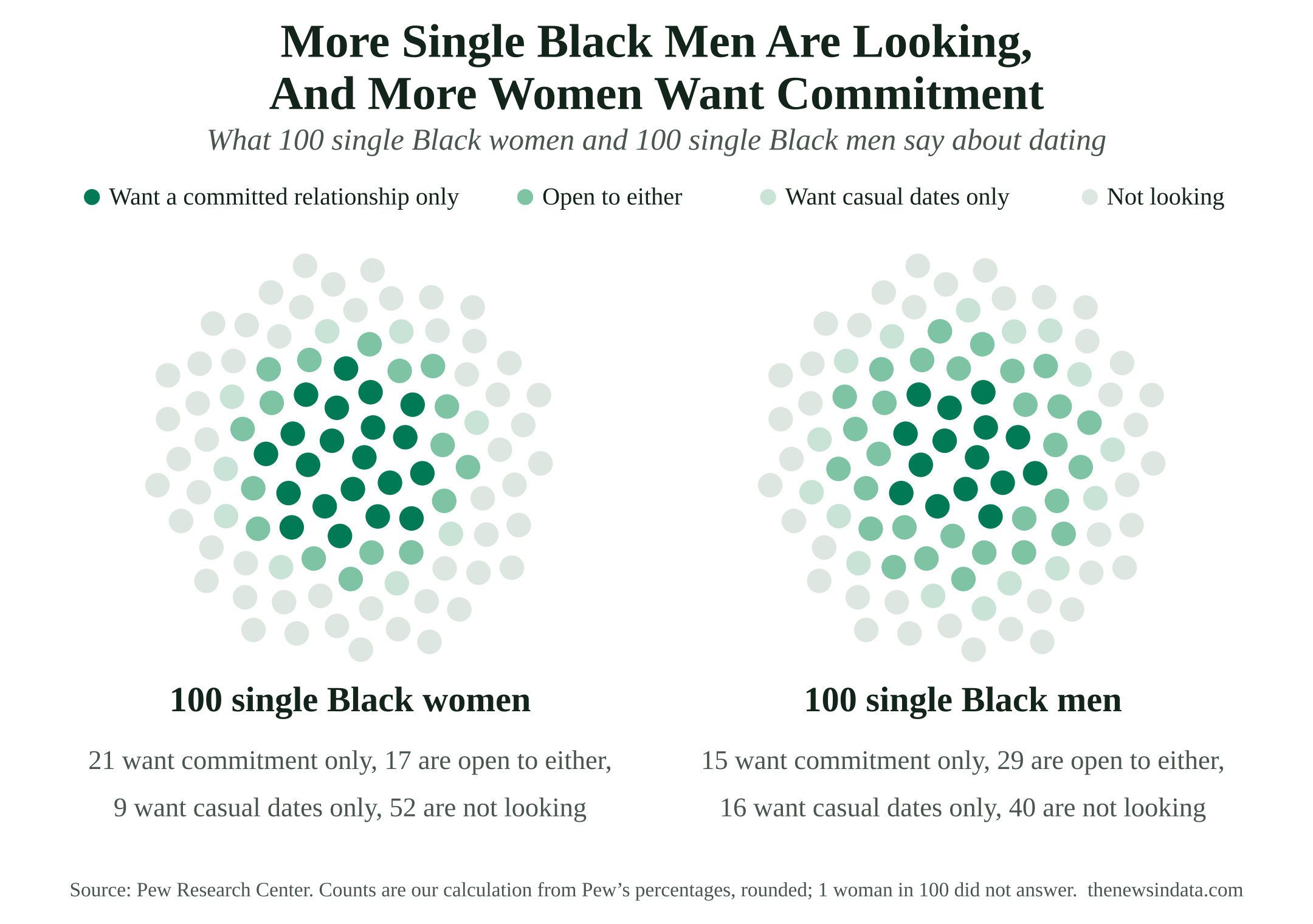
Among those who are looking, 45% of women want only a committed relationship, compared with 24% of men. Men are more likely to want only casual dates (27% to 18%) or to be open to either (49% to 37%).
Put together, the two patterns partly offset. Out of every 100 single Black women, about 21 are looking for commitment only. Out of every 100 single Black men, about 15 are. That is our calculation from Pew's percentages.
What they want in a partner
Large majorities of both women and men want a partner who is caring and compassionate (93% of women, 82% of men), romantic (82% and 68%), helps with household chores (78% and 62%) and believes in God (76% and 62%). Women rate nearly every quality as more important than men do.


Few say a college degree matters much (22% of women, 16% of men), and about a third of each say it is important that a partner wants children.
Dealbreakers
Debt is the most common dealbreaker: 56% of those looking would probably or definitely not consider a committed relationship with someone who has a significant amount of debt, including 64% of women and 48% of men.
The largest gap is over earnings. Forty-two percent of women would rule out someone who makes significantly less money than they do, compared with 18% of men. Almost no one, 10% of women and 12% of men, would rule out someone who makes significantly more.
Women are also more likely to rule out someone who does not vote (42% to 26%) or has different religious views (45% to 30%). Men and women are similar on distance (46% of women and 40% of men would rule out someone who lives far away) and on a partner raising children from another relationship (36% and 40%).
Why they say they are single
Asked for the major reasons they are not in a relationship, the most common answer was not having had luck with dating in the past, chosen by 40% of women and 30% of men. Men were more likely to say they are not financially stable enough, 30% to 19%. About a quarter of each said they just like being single.


What to keep in mind
The partner and dealbreaker questions were asked only of Black adults who are single and looking, a subset of the 4,271 Black adults in the survey, so the margins of error are wider than for the full sample and small gaps between men and women may not be meaningful. The report compares Black men and women with each other. It does not ask the same detailed questions of other groups, so it can't say whether these gaps are larger or smaller than among singles of other races.
How we counted: All figures are from Pew Research Center's "The Dating Attitudes of Single Black Adults," published Nov. 12, 2026, based on a survey of 6,871 U.S. adults, including 4,271 Black adults, conducted June 16 to 29, 2025. We transcribed the figures from Pew's charts. Dealbreaker and reason questions exclude widowed respondents. The "out of 100" counts multiply Pew's share who are looking by the share seeking each kind of relationship and round to whole people. Pew Research Center report. Download our data (CSV).