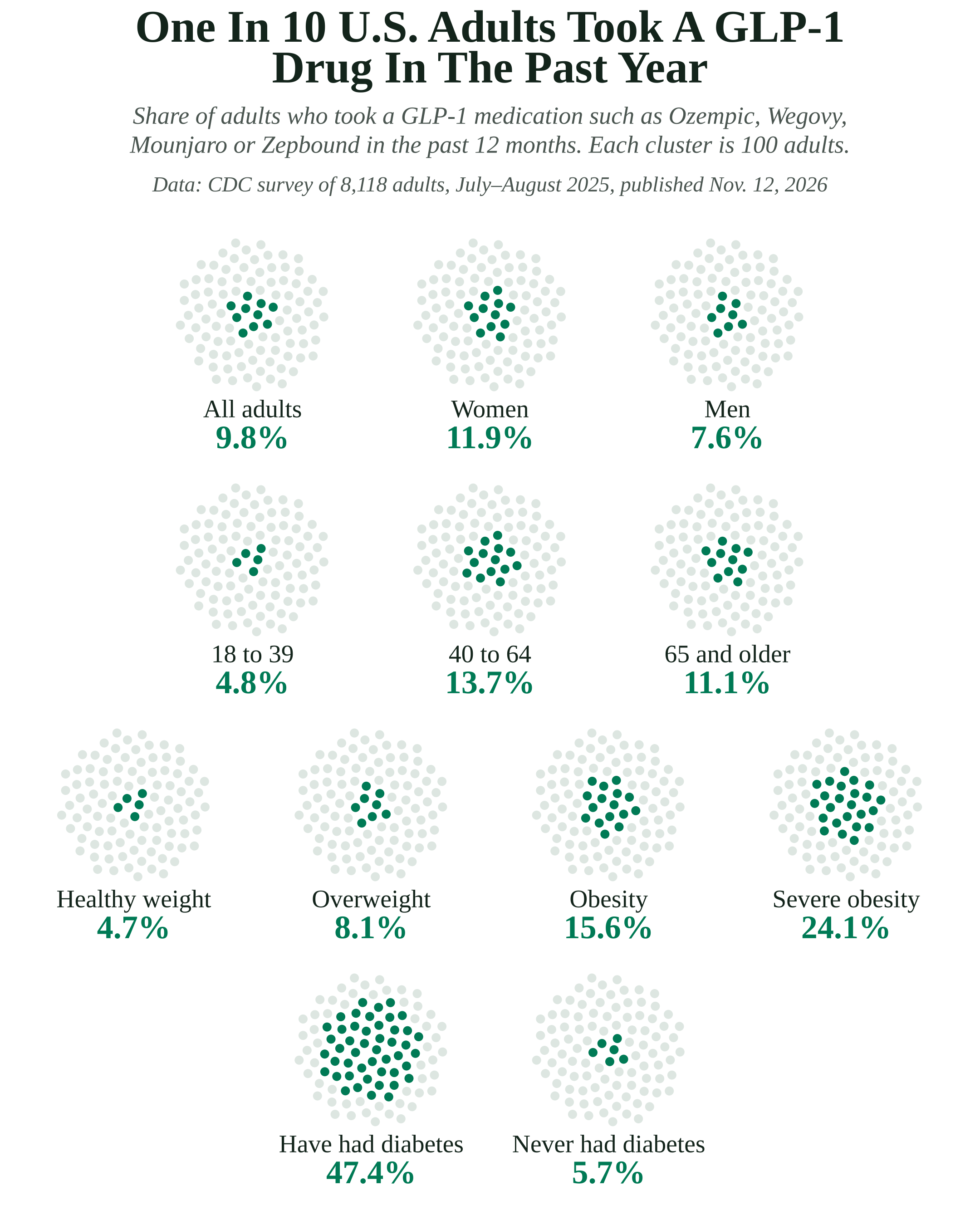
About one in 10 American adults, 9.8%, took a GLP-1 medication such as Ozempic, Wegovy, Mounjaro or Zepbound in the past year, according to a CDC survey published Nov. 12. Among adults who have had diabetes the share was 47.4%. Among adults with severe obesity it was 24.1%.
The numbers come from 8,118 adults surveyed in July and August 2025, and they are among the first federal estimates of how widely the drugs are used and how people actually take them.
Pick a group below to see its share. Each dot is one adult in 100.
Who is taking them
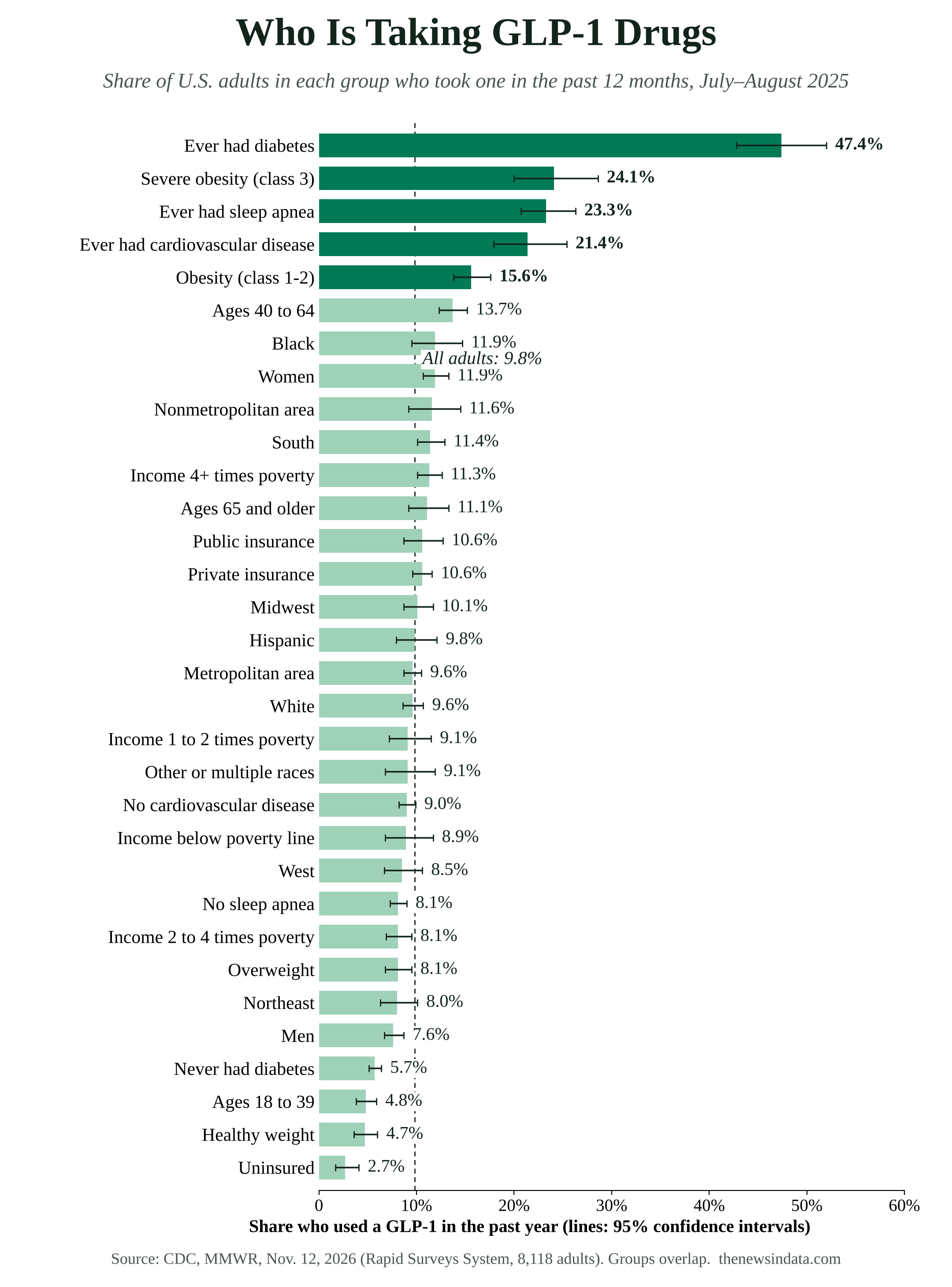
Use peaks in middle age. Among adults 40 to 64, 13.7% took a GLP-1 in the past year, compared with 11.1% of those 65 and older and 4.8% of those 18 to 39. Women (11.9%) were more likely to take one than men (7.6%).


Use rises with weight: 4.7% of adults at a healthy weight, 8.1% of those with overweight, 15.6% of those with class 1 or 2 obesity and 24.1% of those with severe obesity. It was also far more common among adults who have had sleep apnea (23.3%) or cardiovascular disease (21.4%), two conditions the drugs are now approved to treat.
Insurance type made little difference, at 10.6% for both private and public coverage. Having no insurance did: 2.7% of uninsured adults took one.
Most users have overweight or obesity, and one in five do not
Eight in 10 users had overweight or obesity. The CDC says the other 20% could include people with diabetes who don't have excess weight, people whose weight has already dropped into the healthy range, or people taking the drugs off-label.
The survey counted anyone who took a GLP-1 for diabetes or weight loss, so it can't separate the two uses. Diabetes still accounts for a large share: about half of the 976 users in the survey said they have had it.
One in five users took a compounded version
Among people who took a GLP-1, 22.6% said they took a compounded version, a copy mixed by a pharmacy and not reviewed by the FDA for safety, effectiveness or quality. Another 8.8% didn't know whether theirs was compounded.


Compounded versions were more common among women (27.3% of users) than men (14.8%), among people with private insurance (25.9%) than public (12.5%), and among users who have never had diabetes (34.9%) than those who have (9.4%).
Four in 10 users don't take it as prescribed
Overall, 44% of users said they had changed how they took the medication from the way it was prescribed. Skipping doses was the most common change, reported by 28%.
Younger users did this far more often. Among users 18 to 39, 54% had modified their use, compared with 30% of those 65 and older, and 37% had delayed filling a prescription, compared with 6%.
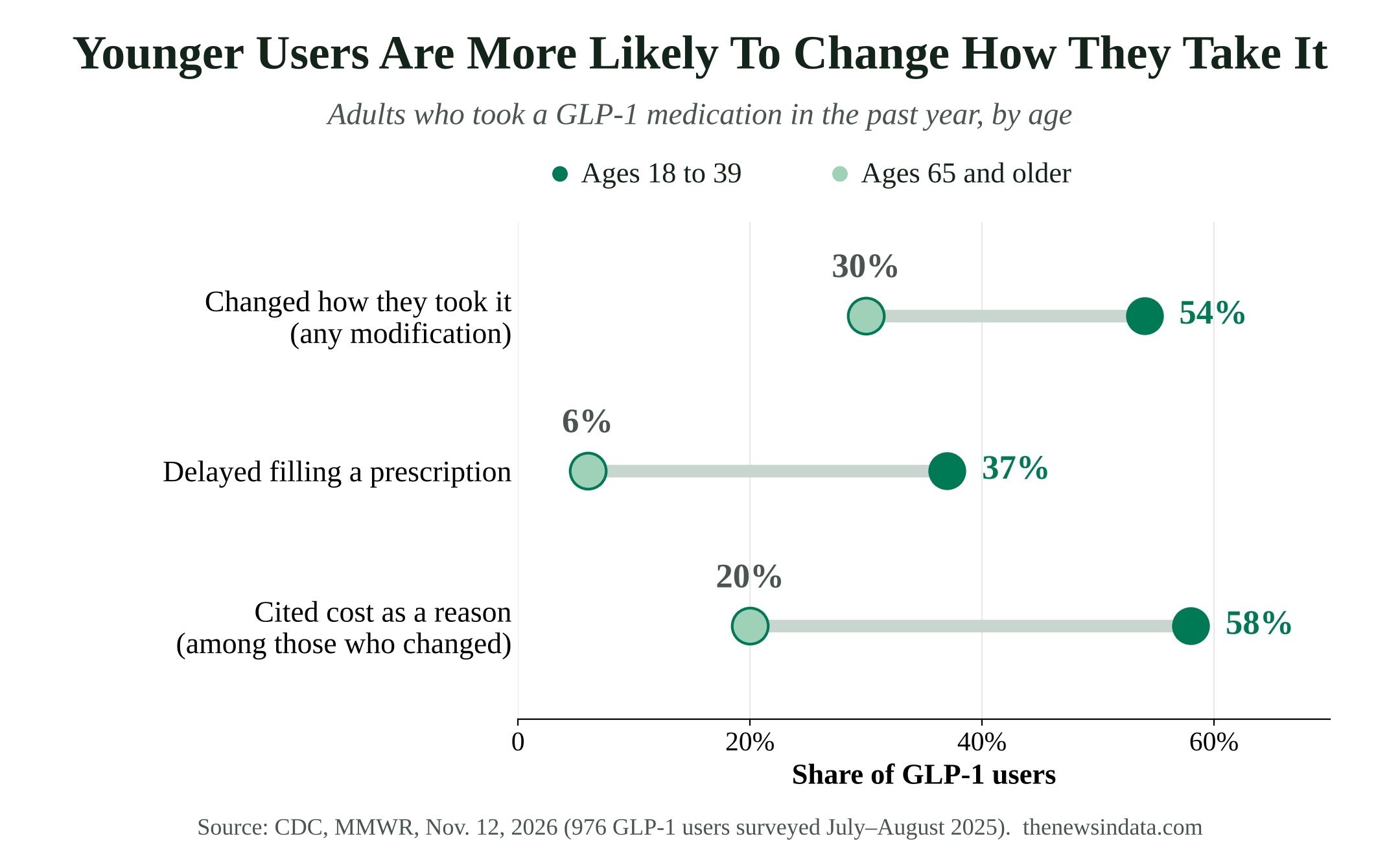
Among those who changed their use, 38% cited cost and 36% cited availability. Cost was a reason for 58% of the youngest group and 20% of the oldest. About 12% of all users said they had cut back or stopped because of side effects.
What about people in their 20s
The CDC did not break out college-age adults. Its youngest group is 18 to 39, and at 4.8% it has the lowest use of any age group, about one adult in 21. The users in that group stand out in other ways: 28% took a compounded version, the highest share of any age group (the samples are small, and the gap with older users is within the margin of error), and they were the most likely to skip, stretch or delay doses because of cost.
The survey also can't see what may be the fastest-moving part of the story for that age group. Its question named approved drugs. It did not name retatrutide, a next-generation drug from Eli Lilly that is still in clinical trials and has not been approved by the FDA, but is sold online as a "research" peptide. A study in JAMA Network Open in October found 13,589 Reddit users who described currently using it in posts through December 2025; the authors could not verify what was in the products or the doses. The FDA has warned about unapproved retatrutide being sold directly to consumers.
Nobody has published a national estimate of how many people in their 20s use retatrutide or other gray-market versions. Reports of heavy use on college campuses are anecdotal for now, and a survey like this one would likely undercount it.


What to keep in mind
These are survey answers, so they depend on people remembering and reporting accurately. The survey ran on online panels with low response rates, which the CDC adjusts for by weighting to its larger National Health Interview Survey. The groups are single characteristics, so the data can't say what share of, for example, women in their 50s with diabetes take the drugs. And the fieldwork is from mid-2025; prices, supply and insurance coverage have kept changing since.
How we counted: All figures are from the CDC's Morbidity and Mortality Weekly Report, Nov. 12, 2026 (Pierce and others), based on Round 7 of the Rapid Surveys System, July to August 2025, 8,118 adults, of whom 976 reported taking a GLP-1 in the past 12 months. The question named Ozempic, Rybelsus, Wegovy, Mounjaro, Zepbound, Saxenda, Victoza, Trulicity, Byetta and Bydureon BCise. In the dot charts each cluster is 100 adults and the filled dots are the share rounded to the nearest whole person. Bars show the CDC's 95% confidence intervals. CDC report. Download our data (CSV).